
Betel vine
Piper betle
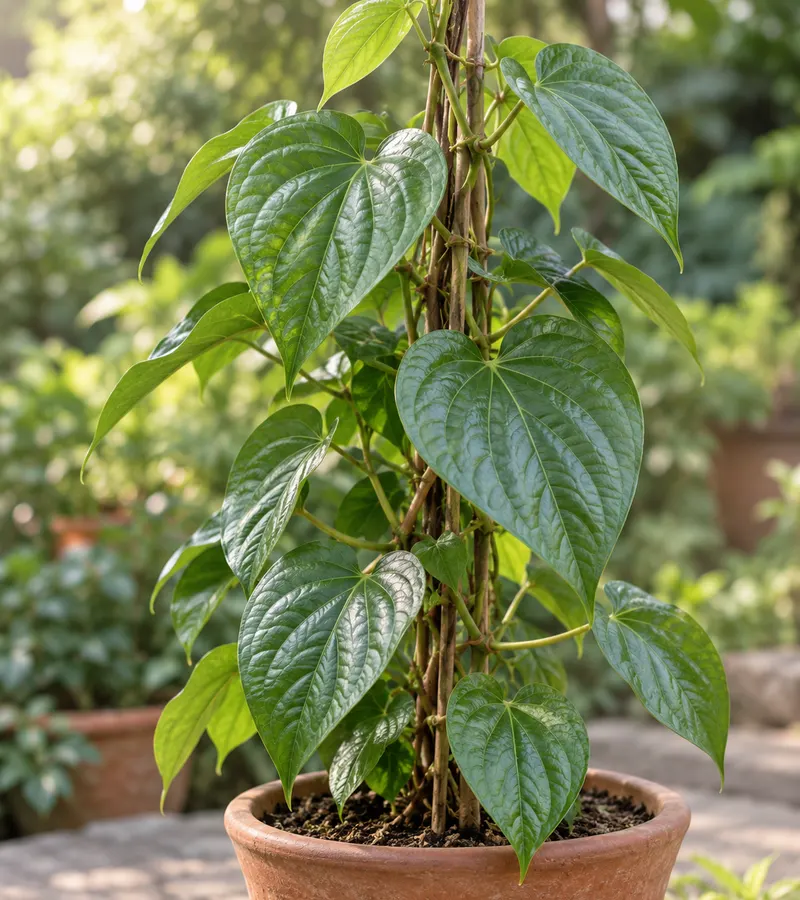
Glossy heart-shaped leaves tied to wedding customs and the traditional betel quid.
Care and placement
Prefers part shade and wind shelter, morning sun and afternoon shade, 70–90% humidity, friable humus-rich moist but not waterlogged soil, and a trellis or pole to climb; cuttings with 2–3 nodes.
Draft mature dimensions
Maximum height (cm): 300 cm · Maximum spread (cm): 100 cm
Things to consider
Betel leaf is used in customs (the betel quid) and folk medicine; do not use it heavily or long-term, especially chewed with areca nut or tobacco, which health bodies link to oral cancer. Grow it as an ornamental or use washed leaves in small amounts.
How to grow and care for it
Planting and pot
Give a stake, moss pole or trellis for the aerial roots to grip; deep, friable, humus-rich, draining soil; avoid waterlogged, saline or alkaline soils. Plant cuttings in moist coir–perlite mix.
Light
Morning sun and afternoon shade; harsh midday sun scorches leaves; shelter from wind.
Watering
Keep soil evenly moist but not waterlogged (it rots roots); 70–90% humidity prevents wilting and dry leaf edges.
Feeding
Humus-rich soil and well-rotted compost are enough. (The sources checked give no specific schedule.)
Pruning
Pick mature, large, dark glossy leaves, each vine 3–4 (occasionally 5) times a year; tie vines to the support and trim overlong runs to branch.
Propagation
Cuttings 12–15 cm with 3–4 nodes (or 12–15 cm with 2–3) in the warm season; strip lower leaves, set in moist coir–perlite at 25–30 °C with high humidity and indirect light; roots form in 2–4 weeks. Seed is impractical.
Pests and common problems
Aphids, spider mites and mealybugs (also scale): strong water spray or neem oil. Fungal white spots and leaf blight: airflow, no waterlogging, organic fungicide if needed.
For a bigger harvest
For many large glossy leaves: part shade, high humidity, humus-rich soil, a sturdy trellis and regular picking. First harvest comes after about 3–8 months depending on conditions.