
Baby rubber plant
Peperomia obtusifolia
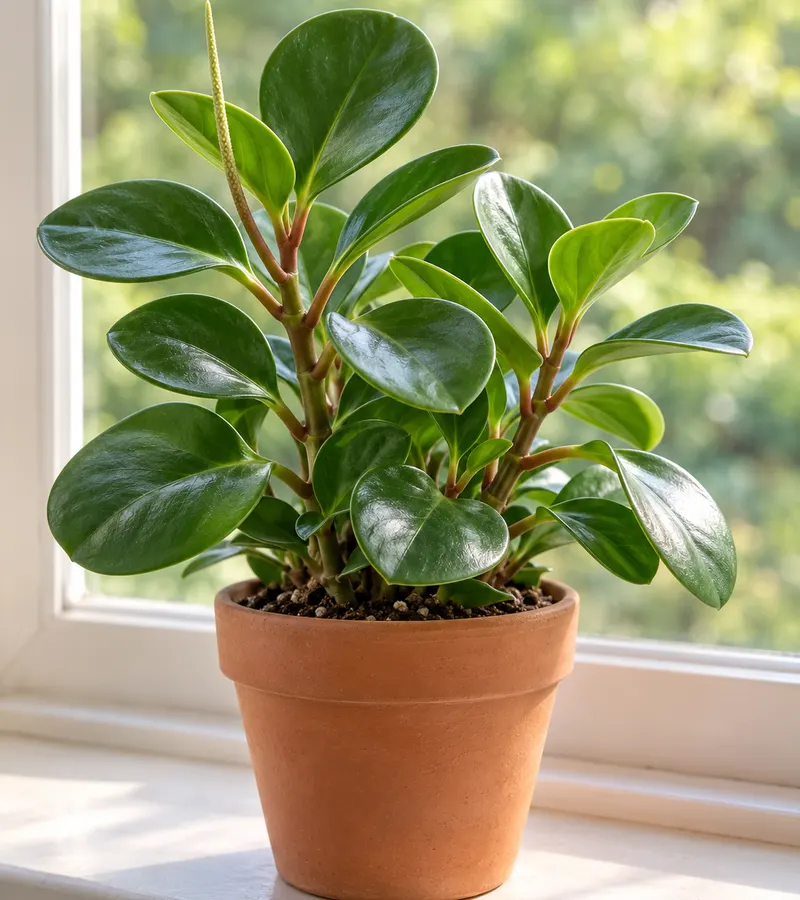
Thick, rounded, glossy leaves like a miniature rubber plant, a tidy fit for a desk near a window.
Care and placement
Prefers bright indirect light and only tolerates dim spots for a few months; let the mix dry between waterings because wet soil causes yellow leaves and root rot; propagate by stem or leaf cuttings; ASPCA lists it as non-toxic to dogs and cats.
Draft mature dimensions
Maximum height (cm): 25 cm · Maximum spread (cm): 30 cm
Things to consider
ASPCA and NC State Extension list it as non-toxic to dogs and cats (NC State also lists horses). These sources say nothing about children or people, so still keep small children from chewing or eating the leaves.
How to grow and care for it
Planting and pot
Plant in a small pot with drainage holes in a well-draining houseplant mix or cactus mix. Choose a pot only slightly bigger than the old one; yearly repotting is not needed, as the plant can stay in one pot for several years.
Light
Bright indirect light near a window is best; harsh direct sun scorches the leaves. NC State says it tolerates low light for several months, especially plain green plants, so treat that as a stopgap: left too long the plant weakens and the leaves lose their fresh shine. A windowless room needs a grow light or a desk lamp placed close; no source gives a specific lux figure.
Watering
It likes the mix on the dry side and tolerates neither soggy nor bone-dry soil: let the top 2–3 cm dry before watering, let the water drain, then return the pot to its saucer. The fleshy stems store water, so it needs little; a Vietnamese source suggests about 1–2 times a week, but check the mix with a finger before watering.
Feeding
Feed only while the plant is actively growing: an occasional low-strength liquid feed, or a slow-release granular feed once a year. There is no need to feed when growth slows or in a dim spot.
Pruning
Remove old leaves as needed. To encourage branching and a fuller plant, cut a stem just above a leaf node. Remove the rat-tail flower spikes if you want the plant to put its energy into foliage.
Propagation
Stem cuttings: take 7–12 cm pieces, strip the lower third of leaves, insert into moist mix, cover with clear plastic and keep out of direct sun. Leaf cuttings: take a leaf with at least 2.5 cm of stalk and insert it in the mix; new plants form at the base of the stalk. Cuttings 10–15 cm long cut just below a node can also be rooted in water in bright indirect light.
Pests and common problems
Root rot from wet mix is the most common disease, along with yellowing and leaf drop from overwatering. Pests include mealybugs, spider mites, whiteflies, scale and fungus gnats; water so the leaves stay dry to avoid fungal leaf spots. It needs a minimum of about 15 °C, so keep it out of cold blasts from an air conditioner.
For plentiful, healthy leaves
For thick, glossy leaves and a tidy shape: give bright indirect light, let the mix dry between waterings, feed lightly while it grows and top the stems at the right time to get branches.