
Watermelon peperomia
Peperomia argyreia
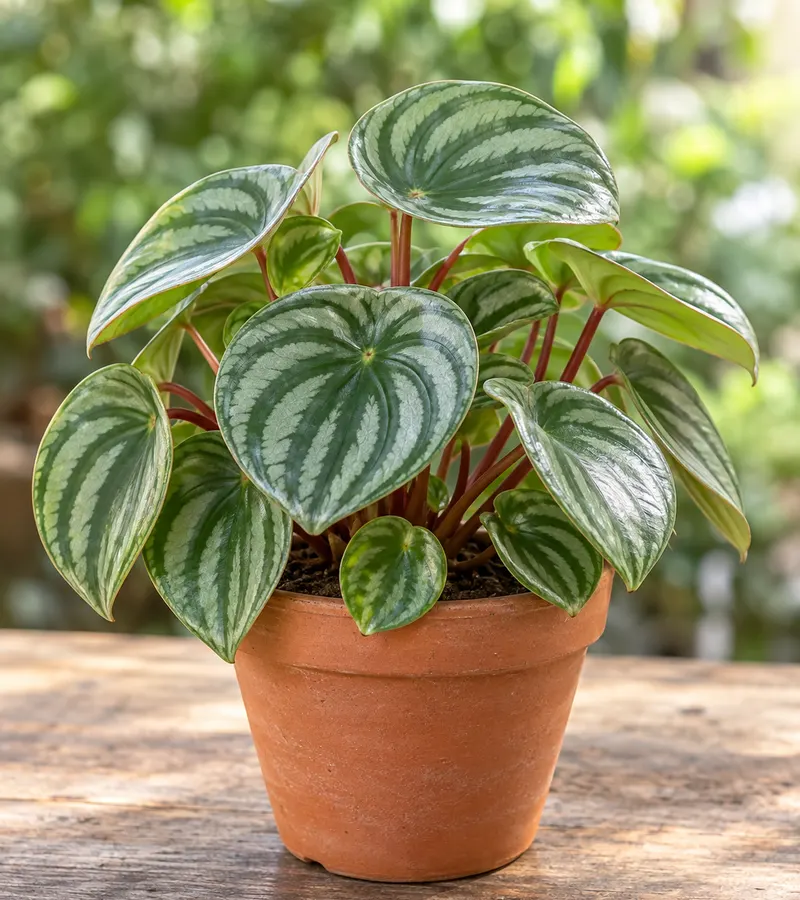
Rounded glossy leaves with silver stripes on green, like watermelon rind, form a compact clump on reddish stalks.
Care and placement
Likes bright light without direct sun and tolerates shade; let the top of the mix dry before watering and water less in the cool season; needs a well-draining pot and air that is not too dry; propagate by division or leaf cuttings.
Draft mature dimensions
Maximum height (cm): 20 cm · Maximum spread (cm): 25 cm
Things to consider
ASPCA lists it as non-toxic to dogs and cats, and NC State Extension also lists it as non-toxic to dogs, cats and horses. These sources say nothing about children or people, so still keep small children from chewing or eating the leaves.
How to grow and care for it
Planting and pot
Plant in a small pot with drainage holes, using a humus-rich mix with some sand or vermiculite added, or a well-draining houseplant mix. Choose a pot only slightly bigger than the old one; the plant does not need yearly repotting.
Light
It likes bright light but not direct sun: harsh sun fades the leaves and slows growth, while too little light turns the leaves darker green and blurs the silver stripes. An east-facing window works well; a spot near a large north-facing window is also tolerated. A windowless room needs a grow light placed close; no source gives a specific lux figure.
Watering
Let the top of the mix dry before watering and water less in the cool season. Overwatering quickly causes root rot, while too little water makes the leaves wilt. It cannot stand wet soil for long, so use drainage holes and empty the saucer.
Feeding
Feed only while the plant is growing: an occasional low-strength liquid feed, or a slow-release granular feed once a year. It is small and slow-growing, so it does not need much.
Pruning
Little pruning is needed: remove old or damaged leaves at the base. To keep it compact and branching, cut a stem just above a leaf node, and remove the rat-tail flower spikes if you want the plant to put its energy into leaves.
Propagation
Propagate by division or leaf cuttings. For a leaf cutting, take a leaf with at least 2.5 cm of stalk, set it in a lightly moist, well-draining mix in bright indirect light; new plants form at the base of the stalk. Division is easiest at repotting time.
Pests and common problems
Root rot from too much water is the main problem, along with leaf drop. Pests include mealybugs, scale, aphids, spider mites, whiteflies and fungus gnats. Keep the humidity steady and mist lightly in hot dry spells; about 21–30 °C suits it and it should not drop below 10 °C.
For plentiful, healthy leaves
For round, glossy leaves with clear silver stripes: give enough indirect light (too little turns the leaves dark green), water just enough for the mix to dry between waterings, keep the air humidity steady and avoid harsh sun.