
Yellow flame tree
Peltophorum pterocarpum
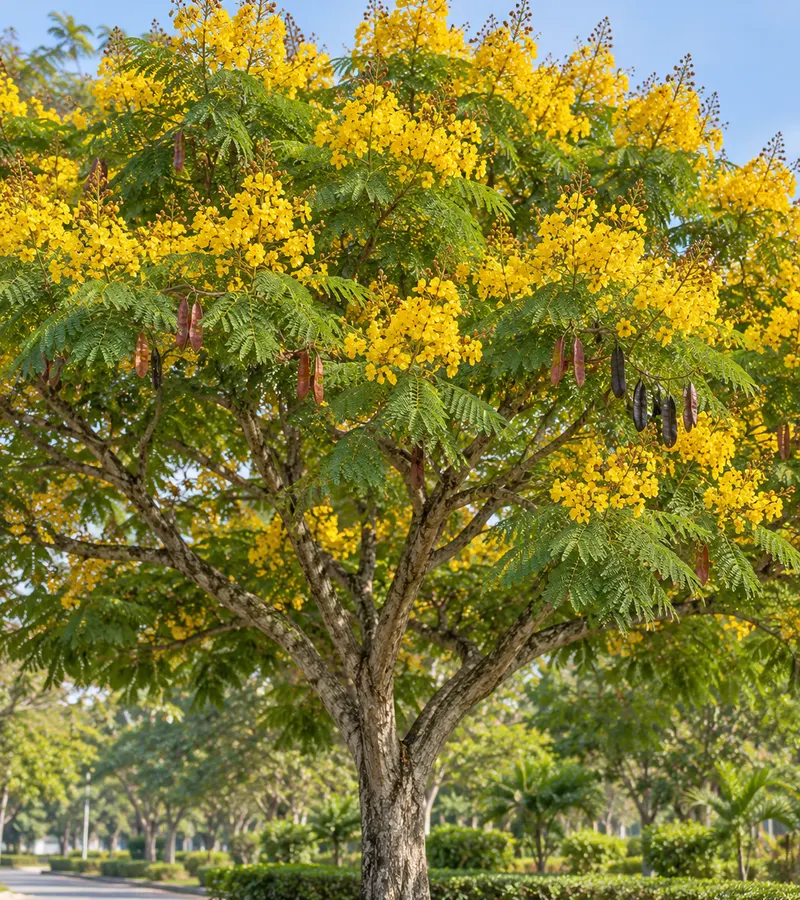
A dome-shaped crown topped in summer by upright sprays of golden-yellow flowers, followed by flat winged pods.
Care and placement
Needs full sun and well-drained soil, is very drought tolerant but does not tolerate sea wind; train one main trunk and strong branches while young and check limbs before the storm season; propagate from treated seed or cuttings.
Draft mature dimensions
Maximum height (cm): 1500 cm · Maximum spread (cm): 1200 cm
Things to consider
The sources checked do not record any toxicity for this tree (PFAF lists no known hazards), but there is no official rating, so it is not claimed safe; do not eat it or use it as medicine, and keep children and pets from chewing it. UF/IFAS warns that it is susceptible to breakage and, with shallow surface roots, can blow over in storm winds; leaves and pods make litter under the crown.
Sources to cross-check
Kew Plants of the World Online · Peltophorum pterocarpumUF/IFAS Extension · Peltophorum pterocarpum: Yellow PoincianaFRIM · Peltophorum pterocarpum: Burst of yellow flamesPlants For A Future · Peltophorum pterocarpumWikipedia (Vietnamese) · Lim xẹtWikipedia · Peltophorum pterocarpumHow to grow and care for it
Planting and pot
Choose a spot in full sun with good drainage, with room for a crown 9–15 m wide and a height of 12–15 m (UF/IFAS gives 30–50 ft and 40–50 ft). The sources disagree on roots: UF/IFAS says large surface roots can form and advises planting about 3 m (10 ft) from pavement, while FRIM says the roots grow deep and seldom damage pavements, so the safe distance from buildings, buried pipes, pavements and overhead lines needs a site survey rather than a general figure. UF/IFAS advises planting only single-trunked trees along streets. Planting on public land needs permission from the tree authority or the land owner. It suits hot climates with a 1–3 month dry season and 1,200–1,800 mm of rain (PFAF), is frost tender (USDA 10A–11 per UF/IFAS) and does not tolerate maritime exposure (PFAF).
Light
Needs full sun; PFAF says it cannot grow in shade and UF/IFAS lists only full sun. The Vietnamese Wikipedia describes it as a light-loving tree. Plant in the open so the crown stays even and flowers well.
Watering
UF/IFAS rates drought tolerance as high, and PFAF says it thrives with a 1–3 month dry season; the Vietnamese Wikipedia says it tolerates heat and drought well. Still, water young trees regularly until established and keep drainage good in the rainy season. After the first year it needs very little care (PFAF).
Feeding
The sources give no specific fertiliser rates. PFAF says it tolerates heavy clay and nutrient-poor soil and that its roots form nitrogen-fixing nodules, so it needs little feeding. Just mix rotted organic matter into the planting hole and mulch the base; avoid heavy nitrogen, which pushes long, weak growth.
Pruning
UF/IFAS says the tree needs pruning to build a strong structure and that street trees need regular pruning because the habit is untidy; to make it less likely to break, keep side stems below half the diameter of the main trunk. Choose and keep one main trunk and remove crossing or forking branches. Leave pruning of large trees or trees near power lines to licensed crews, done before the storm season.
Propagation
Propagate by seed or cuttings (UF/IFAS). Seed needs treatment: scarify it, or soak it in boiling water for 2 minutes followed by an overnight cold soak, which has reached 78% germination (PFAF). Seedlings are raised in a nursery for about a year before transplanting; grafts or cuttings give more uniform roadside trees (PFAF). Trees flower after about 4–5 years (UF/IFAS, PFAF).
Pests and common problems
UF/IFAS lists no serious pests or diseases, and FRIM says wood-boring beetles do not attack it. The main city issue: UF/IFAS says it is susceptible to breakage and that shallow surface roots can let it blow over in storm winds, while PFAF and FRIM call it fairly wind-firm, so judge the risk tree by tree and site by site. Leaves and pods make litter under the crown; the flat winged pods are 5–10 cm long. It drops leaves in unusually cold weather (UF/IFAS). UF/IFAS rates tolerance of aerosol salt as low and PFAF says it does not tolerate maritime exposure. The sources say nothing about allergenic pollen or scent.
For more flowers
For more flowers: give full sun, good drainage, prune for an even crown and wait for the tree to mature (about 4–5 years). The golden-yellow flowers, 2.5–4 cm across, open in sprays above the crown in summer (Wikipedia, FRIM), mostly from May to September according to UF/IFAS.