
Passion fruit
Passiflora edulis
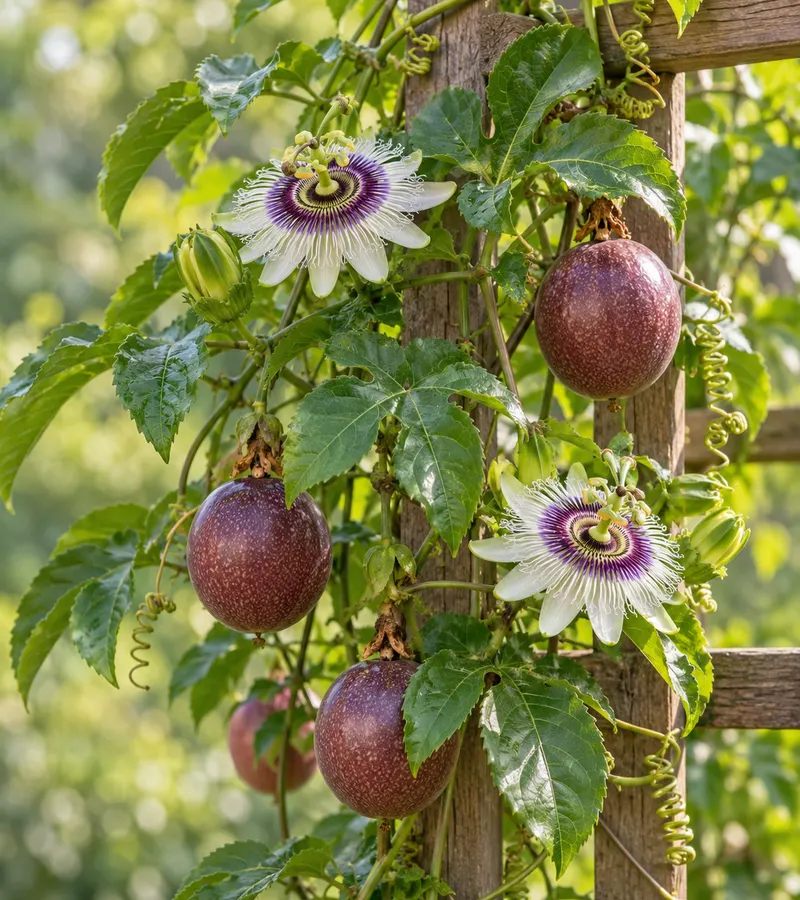
A tendril climber that covers a trellis or fence and gives fragrant tart fruit; it needs full sun and a sturdy frame.
Care and placement
Needs full sun (PFAF: it cannot grow in shade), well-drained soil, and moist soil in the growing season. An evergreen climber that grows fast to about 9 m and climbs by tendrils, so it needs a trellis or fence. It is frost tender (USDA 9–12); Wikipedia: it generally has to be protected from frost.
Draft mature dimensions
Maximum height (cm): 900 cm · Maximum spread (cm): 300 cm
Things to consider
PFAF lists no known hazards, but Wikipedia says the yellow-fruited form contains prunasin and other cyanogenic glycosides in the peel and juice. So eat ripe fruit only, never unripe fruit or peel, and keep children and pets from the vine, leaves and green fruit (a cautious rule; the sources give no safe amount). A heavy, dense climber needs a strong frame.
How to grow and care for it
Planting and pot
Choose a full-sun spot beside a sturdy trellis or fence for the tendrils to grip. PFAF advises restricting outdoor root growth to encourage fruiting, so a bed edge or large pot also works. Avoid frosty places; in hot areas the frame can double as afternoon shade for people below (our inference).
Light
Needs full sun: PFAF says it cannot grow in shade. It flowers in the warm season, and in much shade it will give leaf over flower and fruit (our inference).
Watering
PFAF: it prefers moist soil with plenty of moisture in the growing season, well drained. Water evenly when the top soil dries, especially while flowering and setting fruit, and never waterlog it (our inference). Mulch helps hold moisture.
Feeding
The sources give no feeding schedule. Add well-rotted organic matter at planting and feed lightly to the label when it flowers; avoid heavy nitrogen so it does not make too much leaf (general practice; the sources do not say).
Pruning
PFAF: prune in spring. Remove dead, tangled and overly dense shoots so the frame stays airy and light reaches the canopy. A plant cut back by frost can regrow from the base (PFAF).
Propagation
PFAF: soak seed 12 hours and sow in late winter or early spring somewhere warm, germinating in 1–12 months at 20 °C; young 15 cm heel cuttings in spring or mature-wood cuttings in early summer also work. Use clean planting stock: Wikipedia says woodiness virus can spread through infected scions or contaminated tools.
Pests and common problems
Wikipedia records passion fruit woodiness virus (spread by aphids and mites), cucumber mosaic virus, Fusarium wilt (no chemical control; uproot and burn infected plants and sterilise tools), collar rot, anthracnose and bacterial leaf spot. Once a plant has a virus there is no cure, so replant with clean stock.
For heavy fruiting
For more fruit: full sun, a strong frame, spring pruning and restricted roots as PFAF advises. Hand pollination is recommended for good fruit set (PFAF); Wikipedia says the yellow form is self-sterile while the purple form is self-compatible, and carpenter bees are effective pollinators in California.