
Money tree
Pachira aquatica
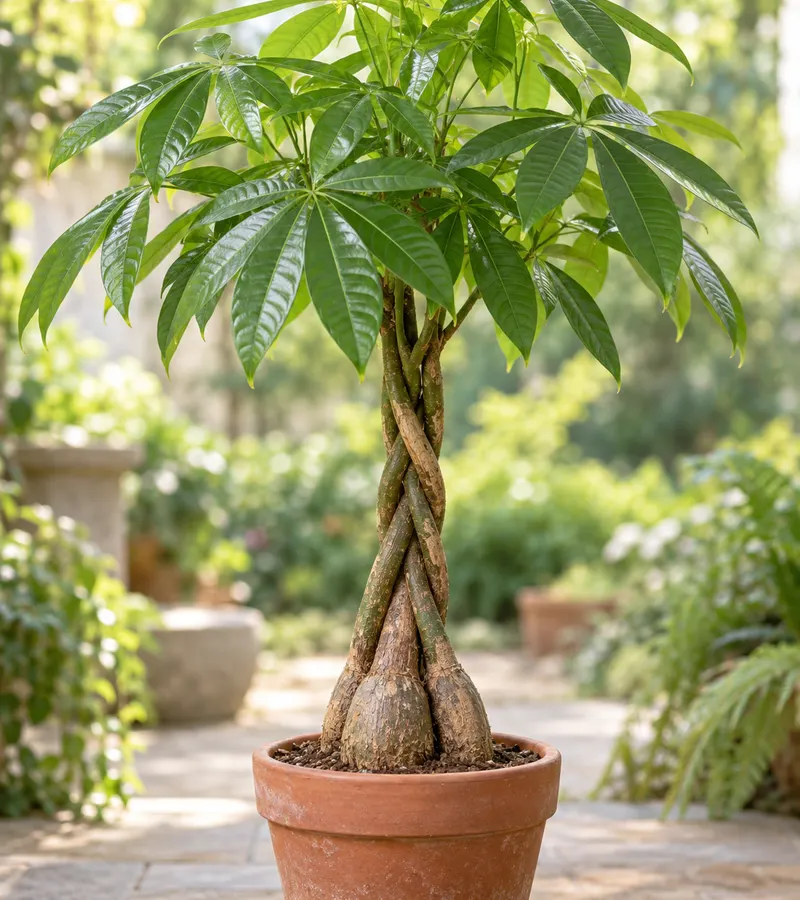
Swollen trunk and palmate leaves, often braided as a living-room feature.
Care and placement
Prefers bright indirect light, tolerates partial shade; water when the top 2–5 cm is dry; use a pot with drainage holes.
Draft mature dimensions
Maximum height (cm): 150 cm · Maximum spread (cm): 100 cm
Things to consider
ASPCA lists Pachira aquatica as non-toxic to dogs, cats and horses, though eating a lot may still cause nausea, vomiting and loose stool. Seeds are eaten in its native range; do not eat them without proper guidance.
How to grow and care for it
Planting and pot
Plant in a well-draining pot with a loose mix. For braided trunks, check that decorative ties do not cut into the thickening stems; repot when roots fill the pot.
Light
Bright indirect light is best; in shade growth slows and new leaves come smaller and paler. Direct harsh sun scorches leaves.
Watering
Let the top 2–5 cm dry, then water thoroughly and empty runoff; more in warm months, less when cool. Waterlogging causes root and trunk rot (Phytophthora/Pythium); drought causes leaf drop.
Feeding
Balanced liquid fertilizer at 1/4–1/2 strength monthly from spring to autumn; stop when cool.
Pruning
Use sharp, clean shears and cut about 1 cm above a node; remove no more than half a stem and avoid cutting into the braid. Hard pruning is best in late winter.
Propagation
Semi-hardwood tip cuttings 10–15 cm long root in water or moist mix in about 3–4 weeks. It can also be grown from seed.
Pests and common problems
Few problems when healthy; spider mites and mealybugs in dry air. Yellow leaves usually mean overwatering; crispy, curling leaves mean low humidity, low light or erratic watering.
For plentiful, healthy leaves
For a fuller canopy: plenty of bright indirect light, steady watering, light feeding in warm months, and tip pruning at the start of the growing season to branch. Indoors it rarely flowers or fruits.