
Banana
Musa acuminata
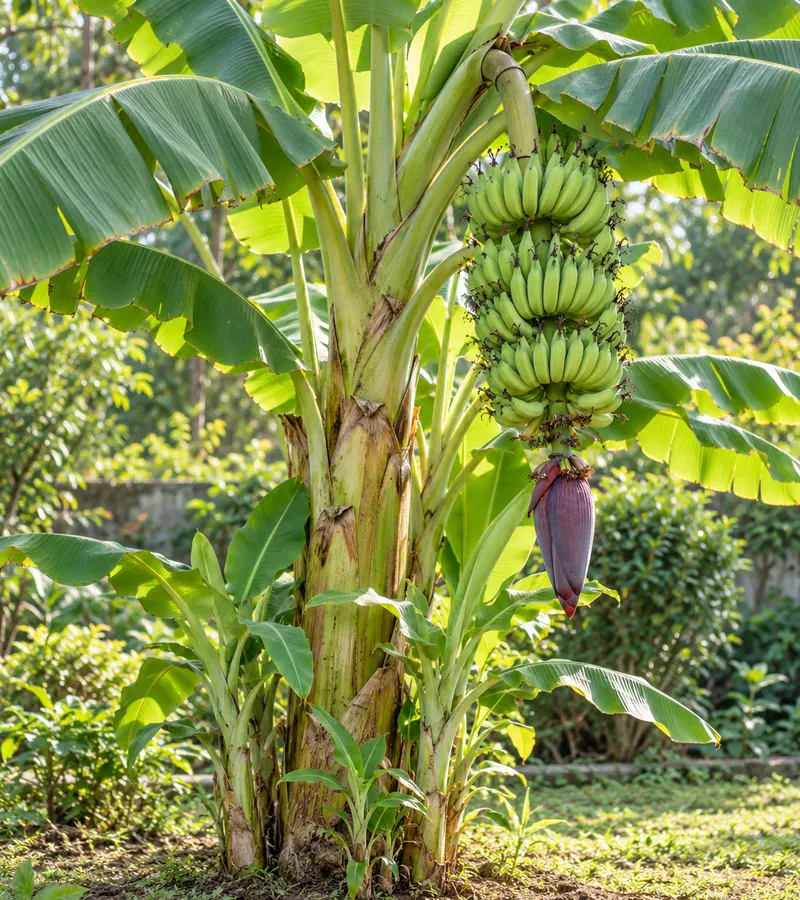
A clump of huge tropical leaves in which each pseudostem fruits once and dies while suckers take its place.
Care and placement
Likes full sun to part shade in a sheltered spot, with well-drained soil, a preferred pH of 6–7.5 and even moisture (PFAF: 1,200–3,600 mm of rain a year preferred). The best daytime range is about 23–33 °C and nights should not fall much below 18 °C while fruit ripens; it is frost tender and can be killed at 1 °C or lower. Wikipedia: flooding harms it.
Draft mature dimensions
Maximum height (cm): 300 cm · Maximum spread (cm): 250 cm
Things to consider
PFAF lists no known hazards, but no official toxicity rating exists for children, dogs or cats, so it is not claimed safe. The huge leaves tear in wind, a clump can fall in storms, and a pseudostem carrying a heavy bunch (Wikipedia: 22–65 kg for commercial varieties) needs support.
How to grow and care for it
Planting and pot
Plant in a sunny, wind-sheltered spot with soil at least 60 cm deep, loose and well drained (Wikipedia: many soils work if deep, draining and not compacted). Plant a sucker divided from a clump; leave room because the clump spreads, and keep it away from walls, houses and pipes.
Light
PFAF: grows in sun or part shade, and another entry says it wants a sunny, sheltered position. Choose plenty of sun with some wind protection.
Watering
It prefers evenly moist soil; Wikipedia notes that water stress is a major concern but flooding also harms it. Water evenly when dry, mulch to hold moisture and make sure the soil drains. Long dry seasons need extra water (our inference; the sources give no amounts).
Feeding
The sources give no feeding schedule. Bananas are hungry plants, so growers usually add well-rotted organic matter and thick mulch around the base; feed lightly to the label and not against the stem (general practice; the sources do not say).
Pruning
Each pseudostem produces one bunch and then dies (Wikipedia), so cut a fruited stem at the base after harvest. PFAF lists a managed multi-stem pattern, meaning surplus stems are removed regularly, and Wikipedia says the plant keeps two shoots (a larger one to fruit now and a smaller follower), so remove surplus suckers so the clump does not crowd (our inference). Trim dead and torn leaves.
Propagation
PFAF: divide suckers in late spring, lift them carefully and pot them in light shade; seed can be sown in a warm greenhouse at about 20 °C but is slow. Wikipedia: plants are propagated asexually from offshoots, keeping two shoots, a larger one to fruit now and a smaller follower.
Pests and common problems
Wikipedia records serious pests and diseases: root-rot nematodes, the banana borer and stem weevil, Panama disease from the soil fungus Fusarium entering through the roots (with no cure) and black Sigatoka leaf spot. Wind-torn leaves are normal. Remove badly diseased plants and never move soil or suckers from a diseased clump.
For heavy fruiting
For a big bunch: lots of sun, shelter from wind, deep humus-rich soil, even moisture, thick mulch and just one fruiting stem plus the next sucker. Wikipedia says a sucker fruits in 6–8 months; fruit turns yellow at about 18 °C, while Cavendish fruit ripened above 27 °C can stay green, so do not ripen it somewhere too hot.