
Orange jasmine
Murraya paniculata
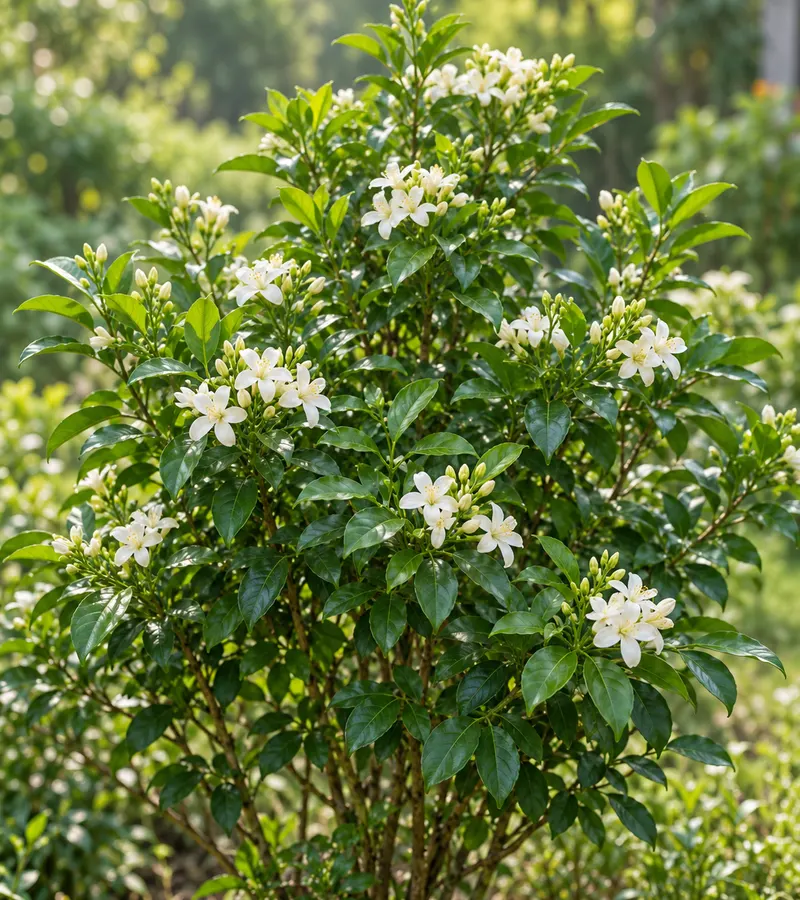
Small sweetly scented white flowers and glossy leaves for ornament or soft hedging.
Care and placement
Needs at least 4–6 hours of sun (afternoon shade in extreme heat), slightly acidic well-drained soil at pH 5.5–6.5 and even watering; trim lightly after each flush; clip hedges every 6–8 weeks.
Draft mature dimensions
Maximum height (cm): 300 cm · Maximum spread (cm): 150 cm
Things to consider
There is no official toxicity rating for this plant, so it is not claimed safe or toxic. Take care: do not eat it or use it as medicine, wear gloves and wash hands after pruning, and keep children and pets from chewing it.
How to grow and care for it
Planting and pot
Plant in sun in loose, slightly acidic (pH 5.5–6.5), well-drained soil; heavy clay rots roots. Use a large pot with drainage holes and repot every 2–3 years in late spring. For hedges, space plants by canopy size.
Light
At least 4–6 hours of direct sun; give afternoon shade in scorching climates to prevent leaf burn.
Watering
Keep soil evenly moist but well drained; water when the top 2–3 cm is dry. Waterlogging causes root rot.
Feeding
Balanced fertilizer in the growing season (slow-release every 4–6 weeks or every 3–4 weeks); stop when cool.
Pruning
Trim lightly after each flush, cutting just above a leaf node to branch; ornamental shrubs are shaped about twice a year and formal hedges clipped every 6–8 weeks.
Propagation
Semi-hardwood cuttings 10–12 cm in summer, dipped in rooting hormone into a perlite–peat mix; roots in 6–8 weeks. Seed from ripe orange berries also works but is much slower.
Pests and common problems
Root rot in heavy, wet soil; leaf scorch in harsh sun without shade. Watch for aphids and scale on new shoots.
For more flowers
For plentiful scented white flowers: enough sun, steady feeding in the growing season, light pruning right after each flush and even watering. It flowers in several flushes a year in warm places.