
Swiss cheese plant
Monstera deliciosa
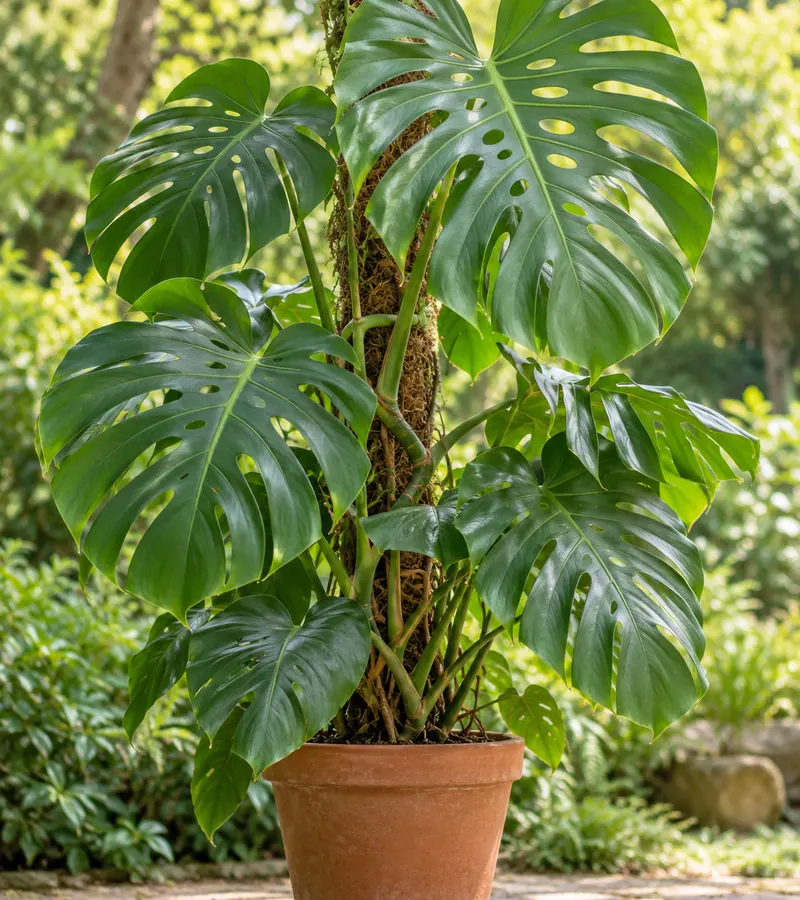
Large lobed and perforated leaves give a living room its signature look.
Care and placement
Prefers bright indirect light, high humidity and roughly 16–29 °C (60–85 °F); water when the top of the mix is dry and give the climbing stem sturdy support.
Draft mature dimensions
Maximum height (cm): 250 cm · Maximum spread (cm): 150 cm
Things to consider
Toxic to dogs and cats through insoluble calcium oxalates: burning, swollen mouth, drooling, vomiting (ASPCA); NC State rates the poison severity as low. Sap may irritate skin. Ripe fruit is edible but unripe fruit burns the mouth; do not eat it unless you are certain.
How to grow and care for it
Planting and pot
Plant in a draining pot with a chunky, airy mix (bark, perlite, coir). Install a moss pole or sturdy stake early so the stem can climb. Repot and prune in spring if needed.
Light
Bright indirect light gives the fastest growth and the strongest leaf splits. Avoid harsh direct sun; variegated forms need more light than dark green ones.
Watering
Water thoroughly, then let the top quarter to third (3–5 cm) of the mix dry before watering again; about every 2–3 weeks when cool. Keep humidity high with a pebble tray or humidifier and wipe dust off leaves.
Feeding
Feed with a balanced liquid fertilizer about monthly in the growing season; reduce or stop when it is cool.
Pruning
Cut yellow or damaged leaves at the stalk base and trim tops to control height or shape. Use a clean knife and gloves; the sap irritates.
Propagation
Stem cuttings: take a section with one node (and an aerial root if present) and a leaf, set the node in water or moist mix. Roots show in 2–4 weeks; pot when about 5 cm long. Air layering also works.
Pests and common problems
Usually few problems; fern scale and spider mites in dry air; root rot if waterlogged. Yellow leaves usually mean overwatering; brown edges mean dry air.
For plentiful, healthy leaves
For bigger, more split leaves: place near a bright window (indirect light), let it climb a moss pole so aerial roots grip, keep humidity high and feed steadily. Young plants always have solid leaves; splits appear on mature plants (often after 1–3 years) with enough light. Indoors it rarely flowers or fruits.