
Weeping paperbark
Melaleuca leucadendra
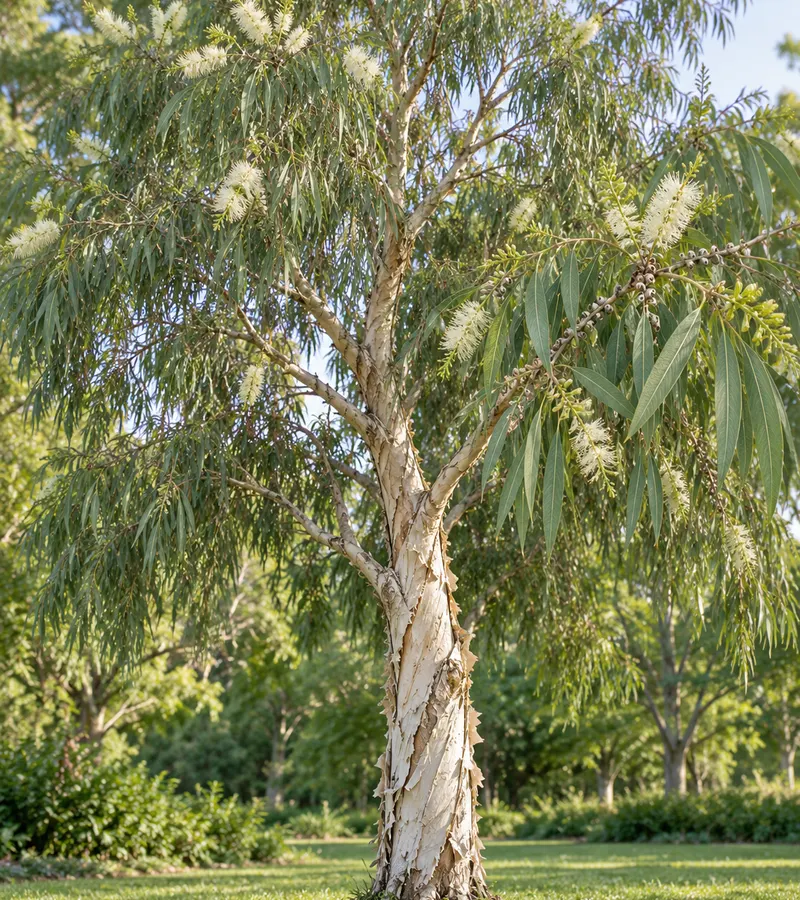
Thin, papery white bark, softly weeping branches and cream bottlebrush flower spikes.
Care and placement
Needs full sun (it will not grow in shade), tolerates moist to waterlogged soil as well as acid-sulphate and saline soils; described as very wind-firm but frost-tender; reaches 12–15 m or more, so it needs room; propagated by seed.
Draft mature dimensions
Maximum height (cm): 1500 cm · Maximum spread (cm): 600 cm
Things to consider
PFAF lists no known hazards, but there is no official toxicity rating for children or pets, so it is not claimed safe; the leaf oil is highly concentrated, should not be self-used, and overdosing may irritate the gut. In a city the main risks are its size, bark that sheds in flakes and very small seeds that spread easily; the sources say nothing about branch brittleness or allergenic pollen.
Sources to cross-check
Kew Plants of the World Online · Melaleuca leucadendraPlants For A Future · Melaleuca leucadendraWikipedia · Melaleuca leucadendraUseful Tropical Plants · Melaleuca leucadendraViện Khoa học Lâm nghiệp Việt Nam · Kỹ thuật trồng tràmPaten Park Native Nursery · Melaleuca leucadendraCutram.vn · Các loại cây tràm ở Việt NamHow to grow and care for it
Planting and pot
Pick a spot in full sun; moist or periodically flooded soil is fine, and seedlings are normally planted at the start of the rainy season (May–June for southern tràm plantations). The sources give no safe distance from buildings, pipes, pavements or overhead lines and do not describe the root system, so a site survey is needed before choosing the spot; allow for a tree 12–15 m tall or more. Planting on public land needs permission from the owner or the street-tree authority. When buying, ask for the scientific name, because "tràm bông vàng" on the market is usually keo lá tràm (Acacia auriculiformis), a different tree.
Light
Needs full sun: the Vietnamese forestry institute calls it fully light-demanding and PFAF says it cannot grow in shade. It suits hot climates, doing best at 28–37 °C and tolerating roughly 18–40 °C, but it is frost-tender, so cold highlands are unsuitable.
Watering
It prefers moist to wet soil; it tolerates seasonal flooding (tràm stands on acid-sulphate soil in the south sit under 0.5–1 m of water for about six months of the rainy season) and drought once established. For a newly planted street or park tree, water regularly until the roots are deep, then rely mostly on rain; it does not need the fast drainage many other trees want.
Feeding
The sources give no feeding schedule. The tree grows on nutrient-poor soil, so mix well-rotted compost into the planting hole and add a light feed only if growth is slow. Avoid heavy fertilizer on flooded ground or beside canals, where it washes away.
Pruning
The sources give no pruning schedule. On a street, remove only dead branches and those touching buildings or wires, and leave large limbs or work near power lines to a qualified arborist. The peeling white bark is natural and should not be stripped, and topping the crown ruins the weeping habit.
Propagation
Propagate by seed. The seed is tiny (about 23 million per kg), collected from ripe capsules in November–December from trees 8–25 years old, and germinates in 7–10 days. The Vietnamese forestry institute plants seedlings about 12 months old and 0.5–0.7 m tall; PFAF lists seed as the only method.
Pests and common problems
Because the seed is tiny, PFAF warns the tree can escape cultivation and become a weed on some sites. Bark flakes, leaves and woody capsules make litter under the crown, and the fragrant flowers open nearly all year and draw bees and birds. The sources do not rate branch strength in storms or pollen allergy, so a large tree near houses needs an arborist's check of its limbs after the typhoon season. It usually survives fire, but plantations still need fire protection in the dry season.
For plentiful, healthy leaves
For a handsome crown, weeping branches and clear white bark: give full sun, moist soil and enough room that it never needs topping, with a light feed when needed. It repays you with fragrant cream bottlebrush flowers that draw bees and birds.