
Champak
Magnolia champaca
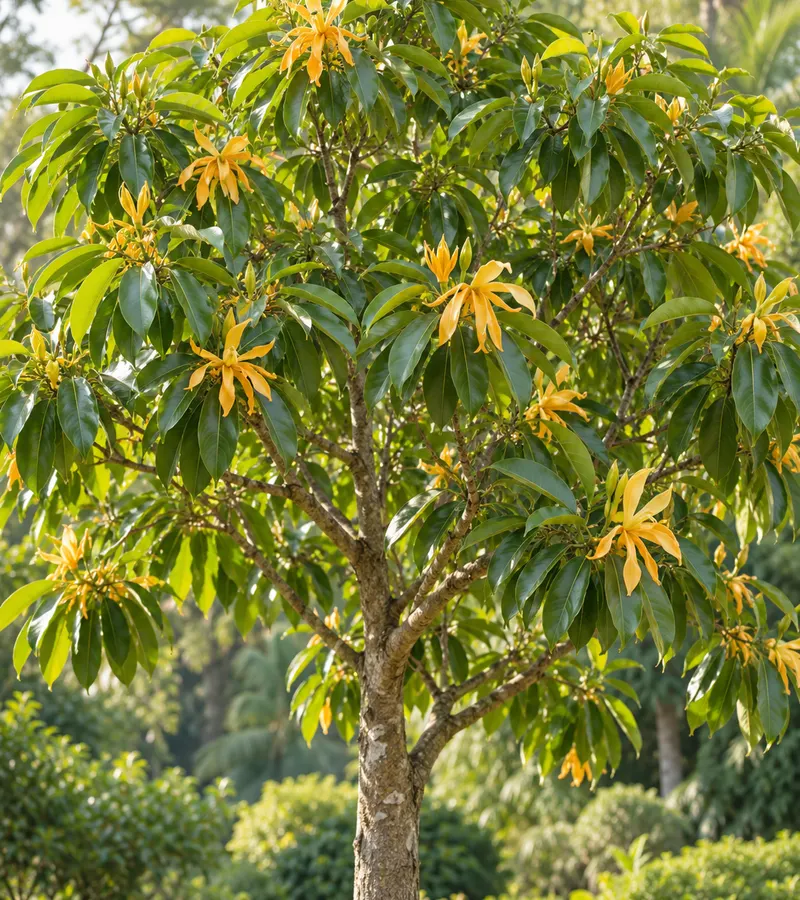
Strongly scented orange-yellow flowers on a tall shade tree.
Care and placement
Needs at least 4–6 hours of sun (full sun is best), moisture-holding well-drained loam and even watering; low nitrogen for flowers; light pruning in late winter; propagated by grafting, air layering or seed.
Draft mature dimensions
Maximum height (cm): 1000 cm · Maximum spread (cm): 400 cm
Things to consider
There is no official toxicity rating for this plant, so it is not claimed safe or toxic. Take care: do not eat it or use it as medicine, wear gloves and wash hands after pruning, and keep children and pets from chewing it.
How to grow and care for it
Planting and pot
Plant in sun in humus-rich loam that holds moisture yet drains well; leave room as it grows large. Young trees need protection from harsh sun and frost.
Light
Full sun is best, tolerating part shade when young or in extreme heat; at least 4–6 hours of direct sun (some sources 6).
Watering
Water regularly, letting the topsoil dry slightly between waterings; keep soil moist without waterlogging.
Feeding
Balanced organic or slow-release fertilizer (about 10-10-10) in early spring before growth; avoid excess nitrogen which gives foliage over fragrant flowers; stop in late autumn for rest.
Pruning
Shape young trees to a strong central leader; leave mature trees natural since heavy pruning reduces flowers. If pruning, do it in late winter to early spring: remove dead or diseased branches and thin for airflow.
Propagation
Fresh seed (remove the fleshy aril) germinates slowly in 4–8 weeks; air layering on semi-mature wood in the rainy season, detached after 10–12 weeks; grafting onto Magnolia rootstock gives earlier flowering. Seedlings take years to flower.
Pests and common problems
Fairly pest-resistant; scale, mealybugs and aphids on young shoots; also spider mites, powdery mildew and leaf spot.
For more flowers
For more flowers: full sun, low nitrogen, even watering, no heavy pruning and patience until maturity (grafted plants flower sooner). Strongly scented orange-yellow flowers open on a tall tree.