
English lavender
Lavandula angustifolia
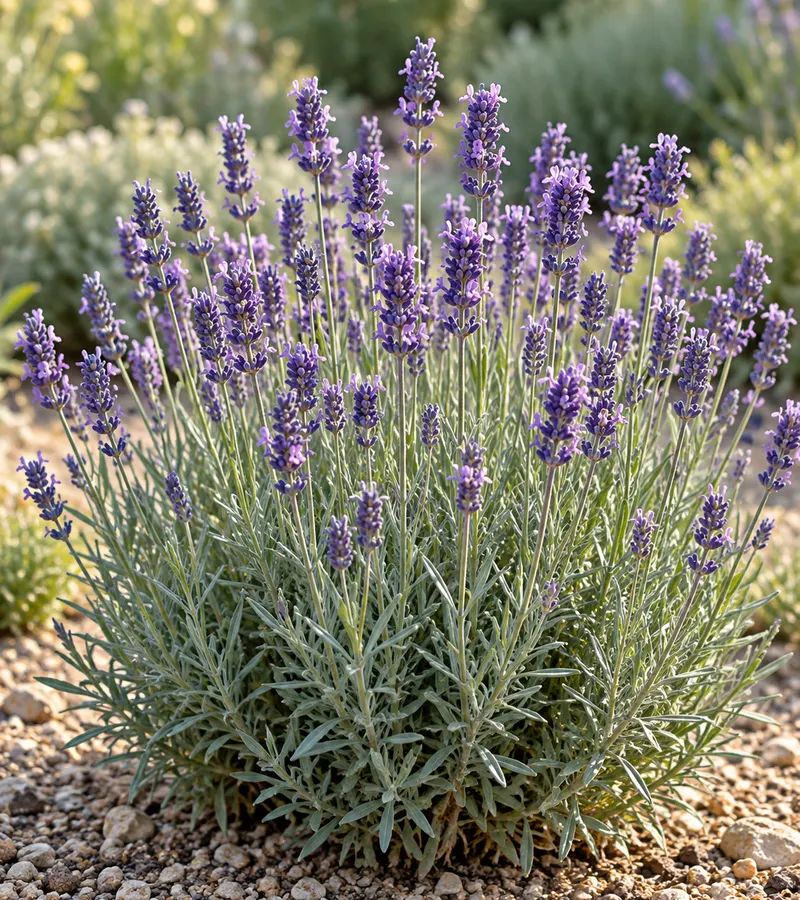
A fragrant grey-green shrub with purple flower spikes that needs full sun and very sharp drainage and suits cool uplands better than hot humid plains.
Care and placement
Needs full sun (PFAF: it cannot grow in shade) and well-drained soil, even acid to alkaline and slightly saline soil; established plants tolerate drought. Hardy to about −10 to −15 °C (USDA 5–8). Wikipedia: it does best in Mediterranean climates with wet winters and dry summers, does not grow well in continuously damp soil and may be short-lived. No source confirms it does well in Vietnam's hot humid plains, so treat it as a cool-climate plant and try it cautiously elsewhere.
Draft mature dimensions
Maximum height (cm): 120 cm · Maximum spread (cm): 100 cm
Things to consider
ASPCA lists lavender as toxic to dogs, cats and horses (linalool and linalyl acetate; nausea, vomiting and reduced appetite), so keep pets from chewing it. PFAF notes the volatile oil may rarely cause sensitization. No rating exists for young children, so it is not claimed safe. The folk-use information below does not replace medical advice.
How to grow and care for it
Planting and pot
Choose an all-day sun spot with very sharp drainage: a raised bed, a gentle slope or a pot with large drainage holes and added grit so water never sits at the base (our inference from Wikipedia's note on damp soil). PFAF: it reaches about 1.2 m tall and 1 m wide and grows slowly; Wikipedia: 1–2 m tall.
Light
Needs full sun: PFAF says it cannot grow in shade, and Wikipedia says some cultivars prefer full sun. In too little sun it stretches and flowers poorly (general practice; the sources do not say).
Watering
PFAF: it prefers dry or moist soil and established plants tolerate drought; Wikipedia: it does not grow well in continuously damp soil and is valued for surviving on little water. Water sparingly, only when the soil is dry deep down, and never let water sit at the base.
Feeding
PFAF says richer soils give more leaf and less oil, so do not feed heavily; poor, free-draining soil is usually enough. The sources give no feeding schedule.
Pruning
PFAF: trimming is best done in spring and not in autumn, and plants are probably best replaced about every 10 years. Wikipedia notes it may be short-lived in some conditions, so root a few spare cuttings.
Propagation
PFAF: sow seed in spring, barely covered; take half-ripe cuttings 7–10 cm long with a heel in July–August (in temperate climates); layering also works. At home the easiest way is a cutting from a healthy, fragrant plant.
Pests and common problems
PFAF names no specific pests or diseases; the biggest problem in both sources is constantly damp soil: Wikipedia says it does not grow well in continuously damp soil, and a PFAF comment warns that wet roots in the cool season kill it. If it wilts in wet soil, water less, improve drainage and cut away damaged growth (our inference).
For more flowers
For plenty of scented flowers: full sun, poor free-draining soil and a spring trim. Wikipedia: flower spikes are 2–8 cm on stems 10–30 cm; PFAF: flowers and tips are used for tea and as a condiment (edible rating 2/5), and the oil is used in aromatherapy, with folk use as a calming herb for sleep (medicinal rating 3/5). That is folk information, not treatment advice.