
Lantana
Lantana camara
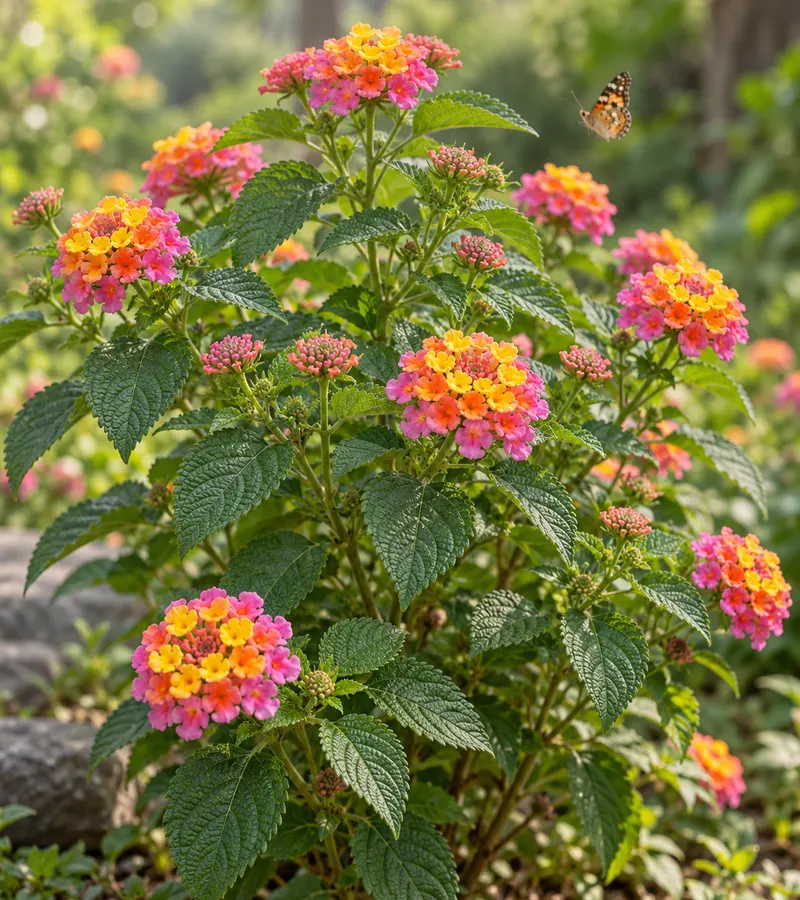
Flower clusters shift from yellow to orange and pink and draw butterflies; spreads fast.
Care and placement
Needs full sun (6+ hours), tolerates drought, drained soil and little fertilizer; invasive in many regions — check local rules and remove fruit to limit spread.
Draft mature dimensions
Maximum height (cm): 120 cm · Maximum spread (cm): 120 cm
Things to consider
TOXIC: all parts, especially unripe green berries, contain triterpenoids: ASPCA notes vomiting, diarrhea, labored breathing, weakness and liver damage in dogs, cats and horses; NC State rates the poison severity as medium. Foliage may irritate skin. Keep berries from children and pets.
How to grow and care for it
Planting and pot
Plant in sun in well-drained soil; pots need drainage holes. Water often right after planting to establish roots.
Light
Full sun, at least 6 hours of direct sun; tolerates partial shade with fewer flowers.
Watering
Once established water only when the soil is dry; drought-tolerant and unsuited to wet sites. Overwatering causes root rot, powdery mildew and sooty mould.
Feeding
Established plants need little: one all-purpose dose in early spring; containers may get liquid feed every 2–3 weeks. Too much nitrogen gives leaves, few flowers.
Pruning
Prune in late winter or early spring to keep compact and bloom; pinch tips during the growing season; old plants can be cut back to about 10–15 cm from the base. Remove spent clusters and fruit. Wear gloves.
Propagation
Stem cuttings in late summer or after flowering with rooting hormone in moist, airy mix; or seed in late winter to early spring. Be careful, as it can spread beyond the garden.
Pests and common problems
Spider mites, whiteflies (most common) and aphids: spray insecticidal soap or neem on leaf undersides. Powdery mildew and sooty mould follow overwatering or shade; sun and airflow prevent most problems.
For more flowers
For continuous blooms: full sun, sparing water, little nitrogen, pinching, removing spent clusters and fruit to trigger new flushes. Flowers shift from yellow to orange and pink.