
Queen's crape myrtle
Lagerstroemia speciosa
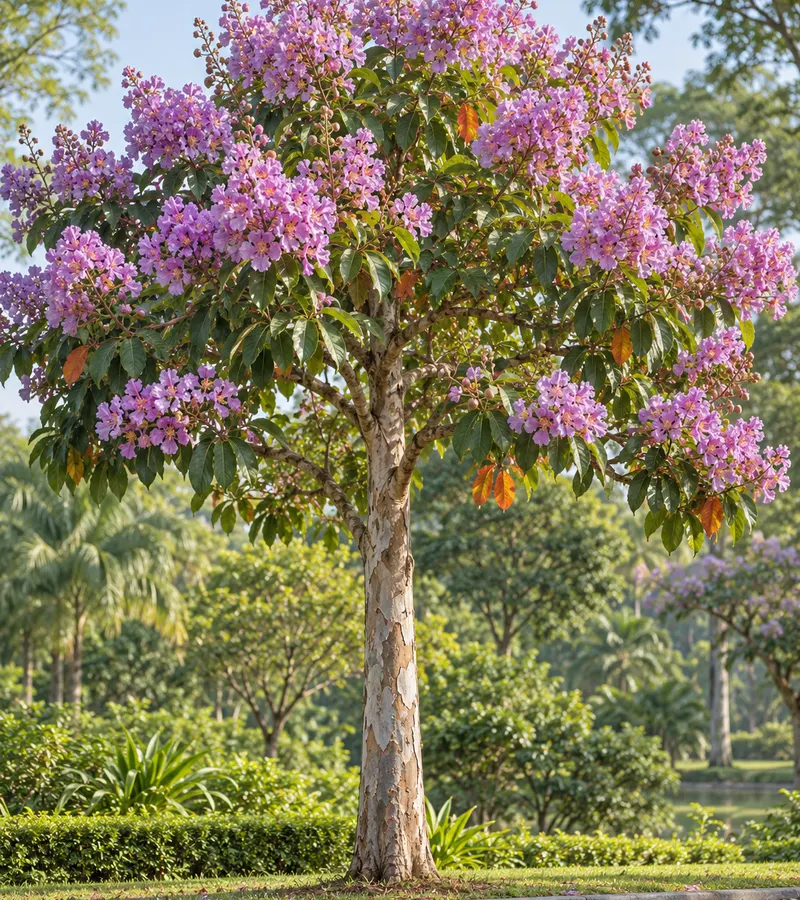
Big clusters of pink-purple flowers open in summer on a much taller tree than the common crape myrtle (Lagerstroemia indica).
Care and placement
Needs full sun (6 or more hours of direct sun a day), humus-rich well-drained soil, tolerates drought once established and is frost-sensitive. Prune only after the leaves drop because flower buds form on new growth; the thin bark is easily injured.
Draft mature dimensions
Maximum height (cm): 1500 cm · Maximum spread (cm): 1000 cm
Things to consider
No source rates its toxicity for children or pets, so it is not claimed safe; the leaves are used in folk medicine and supplements but that is not proof of safety, so do not self-medicate. It grows 9–18 m tall, so pick a spot clear of overhead lines; the thin bark is easily injured by vehicles or mowers.
How to grow and care for it
Planting and pot
Choose a sunny spot with loose, well-drained soil. The tree grows about 9–18 m tall with a 9–12 m spread; UF/IFAS lists it as a large street tree where there are no overhead restrictions and says roots are not a problem, but safe distances from buildings, pipes and pavements are not given and need a site survey. In Vietnam, a forestry guide digs a 50×50×50 cm hole at least a month ahead, mixes topsoil with compost, NPK, phosphate and lime for acid soil, and plants at the start of the rainy season (May–June). Planting on a pavement or public land needs the authority's permission.
Light
Needs full sun, at least 6 hours of direct sun a day. It belongs to warm zones (USDA 10B–11) so frost can hurt it; in a marked dry season it sheds its leaves over a few days or several months depending on how severe the drought is.
Watering
Water generously and regularly for at least two weeks after planting, with mulch around the base; once established it is highly drought tolerant, though regular watering gives a lusher crown. The soil should drain; one source says it can stand some standing water but it is best not to let it waterlog.
Feeding
It likes deep, humus-rich, moist loam; add compost at planting and mulch to hold moisture. On alkaline soil the leaves may yellow (chlorosis), in which case ask a tree-care service or test the soil.
Pruning
Prune young trees to build a strong branch structure; street trees need the low branches removed for pedestrian and vehicle clearance. Avoid frequent annual pruning and prune only after the leaves have dropped since flower buds form on new growth; protect the trunk because the thin bark is easily injured.
Propagation
Mainly grown from seed, sown in shade, which germinates in about 15–56 days; seed-grown plants flower in their second year. It can also be grown from stem or root cuttings, root suckers or marcotting.
Pests and common problems
Aphids and scale are the usual pests, followed by sooty mould; powdery mildew and leaf spot are common diseases. Leaves drop in the dry season, but UF/IFAS says leaves and fruit are not a litter problem. The wood stands storms fairly well if branches are well spaced along the trunk, so build an even frame while young.
For more flowers
For plenty of blooms: enough sun, regular water, humus-rich soil and pruning only after leaf fall. Pink-purple clusters 20–40 cm long open at the branch tips, usually in mid-summer in Vietnam and several times a year in Singapore.