
Thingan
Hopea odorata
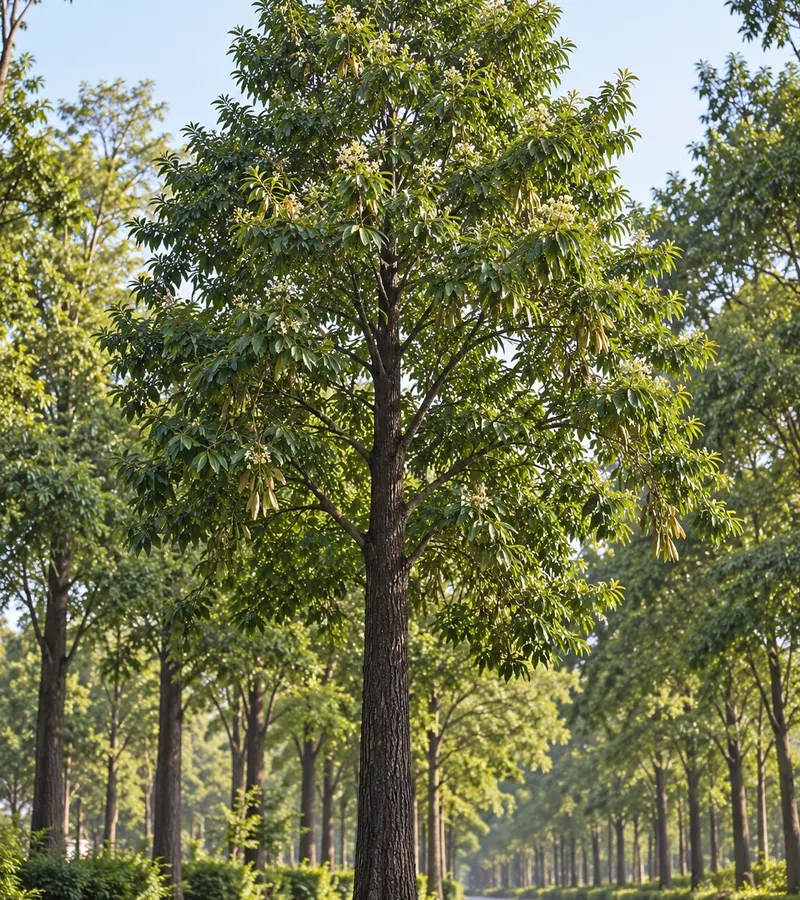
A tall dipterocarp with a straight trunk and pyramid-shaped crown, a familiar shade tree on streets in southern Vietnam and Hanoi.
Care and placement
Needs full sun once grown, deep fertile soil that drains yet stays moist; a very tall tree (20–40 m) for roomy sites only, after surveying distances to buildings, pipes and overhead lines; propagated by fresh seed.
Draft mature dimensions
Maximum height (cm): 2500 cm · Maximum spread (cm): 600 cm
Things to consider
A 20–40 m tree: old specimens can rot, hollow out or lean and shed branches or fall in storms, so they need regular inspection and crown-lightening pruning. The sources consulted give no toxicity or allergenic-pollen information, so safety is not claimed; keep children and pets from chewing it. Planting, pruning or felling on public land needs the authority's permission.
Sources to cross-check
Kew Plants of the World Online · Hopea odorataNParks Flora & Fauna Web · Hopea odorataUseful Tropical Plants · Hopea odorataWikipedia tiếng Việt · Sao đenWikipedia · Hopea odorataTuổi Trẻ · Đốn hàng loạt cây xanh ở TP.HCM vì lo ảnh hưởng bởi bão YagiChính phủ · Nghị định 64/2010/NĐ-CP về quản lý cây xanh đô thịHow to grow and care for it
Planting and pot
Pick a really roomy spot, since the tree can reach 20–40 m: a site survey must settle the distance to buildings, buried pipes, pavements and overhead lines (the decree requires the electricity safety corridor to be kept). Plant in deep, fertile soil that drains yet stays moist, and mulch to hold moisture. It forms large buttresses, so keep it away from foundations and kerbs; planting on a pavement or public land needs the tree authority's permission.
Light
Mature trees need full sun. Seedlings tolerate and even like some shade, but the tree becomes more light-demanding as it grows, so do not plant it under larger trees.
Watering
Water moderately and steadily, especially in the first year and the dry season. It comes from wet tropical country and prefers roughly 3,000–4,000 mm of rain a year, but the soil must drain and not stay waterlogged.
Feeding
The sources consulted give no fertiliser schedule for this species. A safe approach is to mix well-rotted compost into the planting hole, mulch, and keep the soil fertile and moist; its preferred soil is slightly acidic (pH about 4.8–5.2).
Pruning
The trunk is straight and the natural crown pyramid-shaped, so little shaping is needed; remove only dead, diseased or crossing branches. For big trees, have the responsible crew lighten the crown before the storm season. Pruning shade trees 10 m or taller on public land needs a permit under the decree.
Propagation
Propagated by seed, which loses viability fast and dies within about five days if it dries, so sow it fresh. Germination takes 1–4 weeks. Bare-root seedlings that have been root-pruned first survive almost completely.
Pests and common problems
Leaf chewers, stem borers and a seed weevil (Nanophyes) are recorded pests. In cities the main problem is size: old trees can rot, hollow out or lean, large limbs may break in storm squalls, and pavement or pipe works damage roots; Ho Chi Minh City felled and pruned many big sao đen trees before Typhoon Yagi for this reason. It flowers only every few years and its fruits are small and winged, so fruit litter is occasional.
For plentiful, healthy leaves
For a full crown and straight trunk: plant in full sun in deep fertile soil that stays moist, mulch, and stake young trees until the roots hold. The glossy evergreen leaves and tidy pyramid crown look best when the tree has room and unrestricted roots.