
Round-leaf calathea
Goeppertia orbifolia
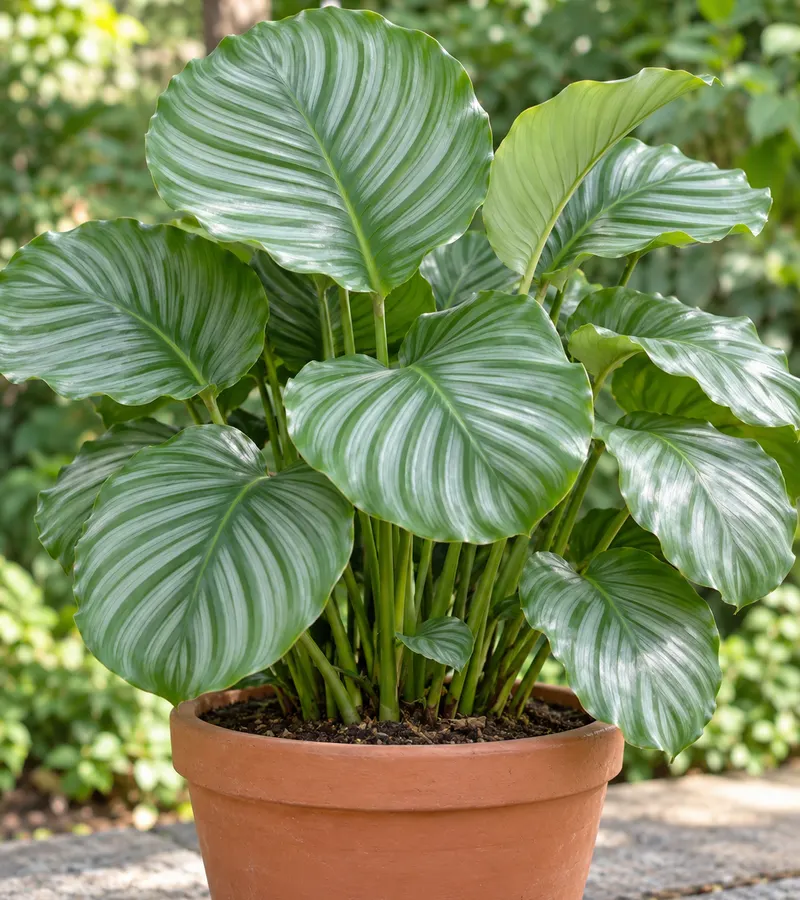
A calathea with large round leaves banded in pale silver-green that wants humidity and indirect light; NC State tags it as non-toxic to cats and dogs.
Care and placement
Needs bright indirect light or part shade, steady temperatures of about 18–24 °C, air humidity of 60% or more and a mix kept evenly moist but not soggy; avoid cold drafts, harsh sun and fluoride-rich tap water.
Draft mature dimensions
Maximum height (cm): 75 cm · Maximum spread (cm): 50 cm
Things to consider
NC State tags the plant as non-toxic to cats and dogs. No source checked for this project speaks about children, so still keep small children from chewing the leaves, and do not treat the plant as food.
How to grow and care for it
Planting and pot
Plant in a pot with drainage holes using a loose, well-draining, slightly acidic, humus-rich mix. Put it where the temperature stays steady around 18–24 °C, away from air-conditioner vents, doors and other cold drafts, because it dislikes draughts and temperature swings. Stand the pot on a tray of wet pebbles or near a humidifier to hold the air humidity up.
Light
It needs bright indirect light or part shade, placed near a window but out of harsh direct sun. Direct sun scorches the leaves, while too little light makes their colour fade. No source gives a minimum lux, and a windowless room needs a plant grow light on for many hours a day.
Watering
Keep the mix evenly moist, watering when the top 2.5 cm or so starts to dry and never leaving it soggy. Rain or distilled water is preferred, or let tap water stand overnight, because fluoride in tap water browns the leaf tips. Avoid wetting the foliage often, which can cause leaf spot.
Feeding
Feed once a month during the growing season, diluted as the label directs. Skip feeding when growth slows in cooler weather.
Pruning
Cut old, damaged or badly browned leaves off at the base. Gently wipe the leaves with a damp cloth regularly to remove dust, which reduces how well the leaves photosynthesise.
Propagation
Divide in spring: lift the plant out of its pot, split it into clumps that each have roots and leaves, and pot them separately in moist, loose mix. Division is the method NC State gives; none of the sources used here covers leaf cuttings.
Pests and common problems
Brown tips and edges usually come from dry air or fluoride in the water; curled leaves from dryness or low humidity; faded colour from too little light; scorching from harsh sun. Overwatering causes root rot. Mealybugs, spider mites, aphids and scale can appear.
For plentiful, healthy leaves
For big leaves with clear silver bands: hold air humidity at 60% or more with a wet pebble tray or a humidifier, keep temperatures steady, use soft water, wipe dust from the leaves and feed lightly each month. Enough bright indirect light stops the colour fading.