
Nerve plant
Fittonia albivenis
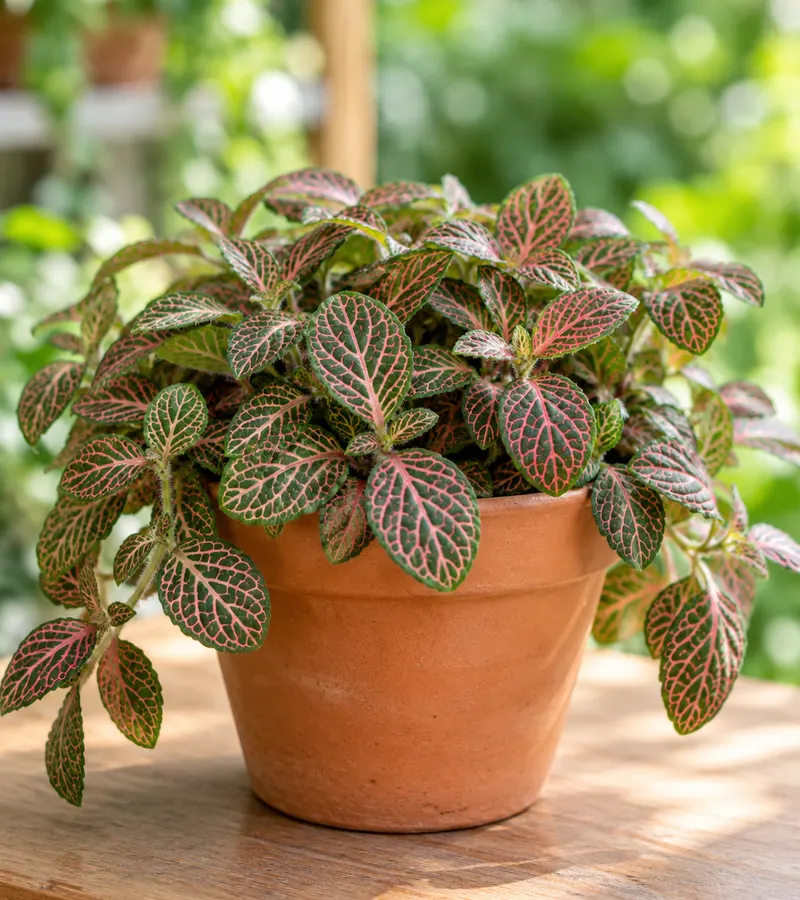
A low, creeping plant with dark green leaves netted in white or pink veins that tolerates shade but wants steady moisture; ASPCA lists it as non-toxic to cats and dogs.
Care and placement
Tolerates shade to medium light, away from harsh sun and drafts; keep the mix evenly moist but not soggy, the air humid and temperatures above about 13 °C; pinch the tips to keep it bushy.
Draft mature dimensions
Maximum height (cm): 15 cm · Maximum spread (cm): 30 cm
Things to consider
ASPCA and NC State both list the plant as non-toxic to cats and dogs (ASPCA also for horses). No source read here speaks about children, so still keep small children from chewing the leaves and do not treat it as food.
How to grow and care for it
Planting and pot
The roots are shallow, so use a small, shallow pot with drainage holes. Choose a humus-rich mix that holds moisture yet drains well; compacted soil combined with poor watering invites stem rot. Grow it indoors only, where temperatures stay above about 13 °C, and keep it away from air-conditioner vents.
Light
It tolerates medium light to part shade: NC State says it does well in bright to medium light and under fluorescent lights, and the Vietnamese source says it prefers shade and low light. Direct sun scorches and shrivels the leaves. No source gives a minimum lux: if the plant weakens and thins out, move it nearer a window or under a lamp, and a windowless room needs a plant grow light on for many hours a day.
Watering
The plant has high water needs: NC State suggests about two waterings a week, and the plant wilts dramatically when dry but recovers fast after a drink. Left dry too long the leaves turn crisp and drop and recovery is slow, while overwatering causes yellowing and root rot. The Vietnamese source advises regular misting or standing the pot in a tray of water.
Feeding
The plant needs little fertiliser: an occasional dose of diluted fertiliser is enough if you want to feed it, and there is no need to feed heavily.
Pruning
Pinch the tips of the creeping stems to keep the plant bushy and full. Remove old or yellow leaves; some old leaves dropping is normal.
Propagation
Stem cuttings are the easiest route because the creeping stems root readily. Take a section with about 3–5 leaves, set it in humus-rich mix and keep it evenly moist.
Pests and common problems
Leaves shrivel, crisp and drop in dry air, drafts or direct sun, and yellowing usually means overwatering. Mealybugs, scale, spider mites, slugs, thrips, leaf spots, root rot and stem rot can occur. In an air-conditioned room dry air and cold drafts are the biggest risks.
For plentiful, healthy leaves
For a dense, attractive carpet of leaves: steady medium light, an evenly moist mix, humid air, no drafts and regular pinching. A small, shallow pot suits its shallow roots.