
Sacred fig
Ficus religiosa
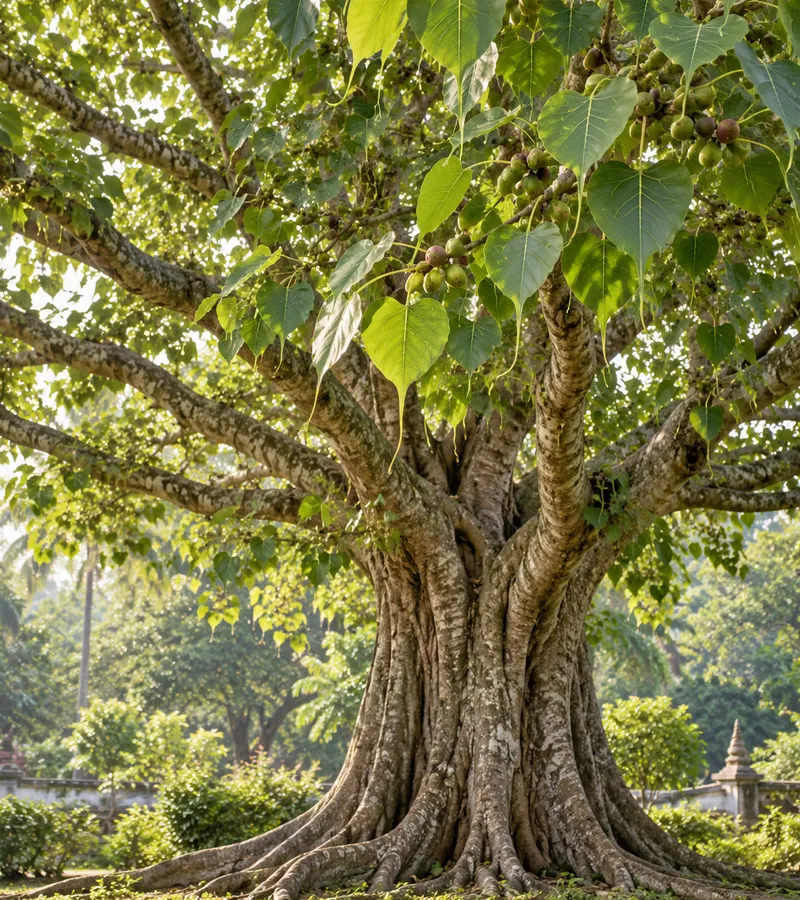
A very large tree with heart-shaped, long-pointed leaves, tied to temple grounds and needing a wide plot for its roots and crown.
Care and placement
Needs full sun (tolerates part shade), deep well-drained soil and even watering while young; it becomes very large so it needs a wide plot and should not be planted tight against structures; propagated by cuttings or seed.
Draft mature dimensions
Maximum height (cm): 1800 cm · Maximum spread (cm): 1500 cm
Things to consider
The RHS lists it as a skin allergen, so wear gloves and protective gear when handling or pruning; other sources state no toxicity, so it is not claimed safe. In a city the tree is very large, can root into walls or damage a host tree it grows on, and fallen figs attract insects.
How to grow and care for it
Planting and pot
Plant only where there is wide open ground, such as temple courtyards, parks or plazas, because the tree reaches 15–30 m with a broad crown and a trunk that can grow metres thick. The sources give no safe distance from buildings, pipes, pavements or overhead lines, so a site survey is needed first. It has a deep taproot but can also root in rock crevices and concrete walls, so do not let it seed into structures. Planting on public land needs permission from the landowner or the tree authority.
Light
Prefers full sun but tolerates part shade. It grows fast in open sites, along roads and rivers, and tolerates air temperatures from about 0 to 35 °C.
Watering
Water young trees regularly until established; larger trees want moist soil that does not waterlog in the rainy season. It copes with little moisture, even growing on walls, but does best in deep, moist soil.
Feeding
It likes good, deep, moist, well-drained soil, so mix well-rotted organic matter into the planting hole. The sources give no feeding rates for trees in the ground, so only feed lightly with organic matter while young and watch leaf colour.
Pruning
Keep a single straight trunk while young: stake it and remove shoots from the trunk and base. A large tree needs little pruning; the RHS says none is required beyond shortening overlong shoots. Wear gloves because it can irritate skin, and use a trained arborist for high crown work.
Propagation
It is usually propagated from semi-mature cuttings 20–30 cm long, which root in about 3 weeks in sand, then spend 12–15 months in the nursery and are planted out when over 2 m tall. Seed (germinating best around 20 °C) or air layering also work.
Pests and common problems
In the city: the tree is very large, so it needs wide ground for roots and crown; roots can push into wall cracks and concrete, and it can grow on other trees and slowly kill the host. Small figs fall onto the street and attract insects, and the tree is semi-deciduous or sheds leaves in the dry season, so litter needs clearing. Some regions class it as an environmental weed, and a Vietnamese source says the deep roots make it rarely fall in storms. The RHS notes possible red spider mite, thrips, mealybugs and scale, mainly under glass.
For plentiful, healthy leaves
For a handsome green crown: give enough sun, deep moist well-drained soil, even watering while young and no waterlogging. The thin heart-shaped leaves with a long pointed tail flutter in the wind, and new leaves start bronze before turning glossy green.