
Mexican snowball
Echeveria elegans
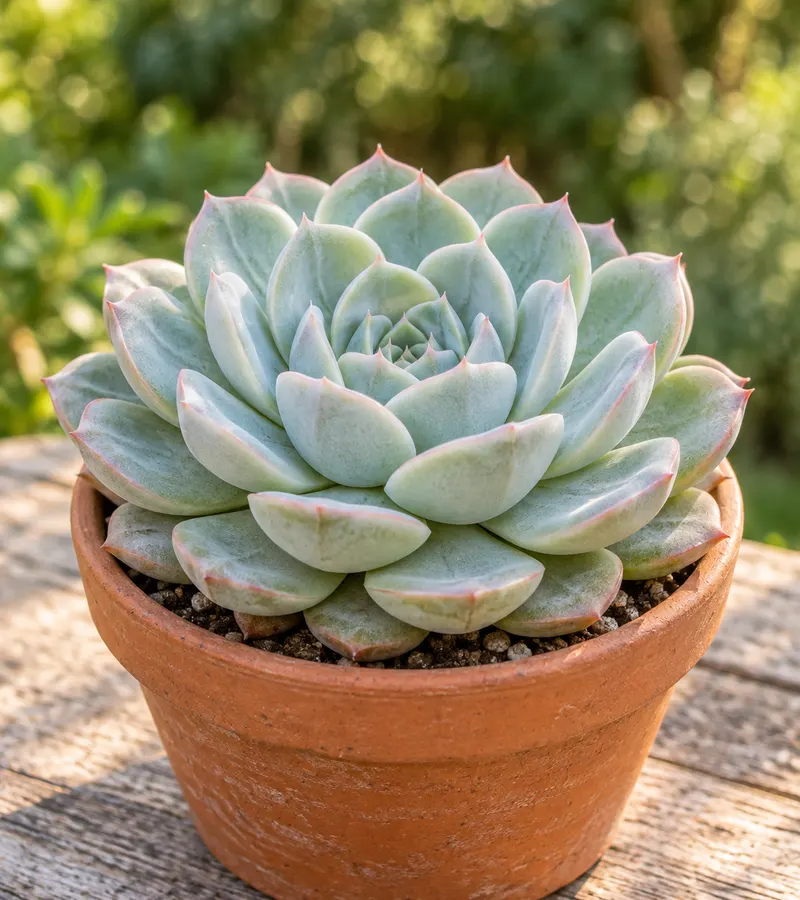
Thick rosettes like lotus flowers in powdery silver-blue, ideal for small pots.
Care and placement
Needs lots of light (4–6 hours of sun or a very bright window), a gritty cactus mix, and a soak-and-dry watering routine.
Draft mature dimensions
Maximum height (cm): 15 cm · Maximum spread (cm): 20 cm
Things to consider
ASPCA lists Echeveria elegans (hens and chickens) as non-toxic to dogs, cats and horses. Still discourage pets from chewing the fleshy leaves.
How to grow and care for it
Planting and pot
Use cactus mix blended about 1:1 with pumice, perlite or coarse sand (pH 6.0–7.0); avoid peat- or coir-dominated mixes. A small pot with drainage holes; a thin gravel layer keeps the base dry.
Light
Needs strong light: 4–6 hours of direct sun or a south/west window. Low light stretches and fades it; sudden harsh sun can scorch, so acclimate gradually.
Watering
Soak, then wait until the mix is fully dry: about 10–21 days in summer, 4–6 weeks in winter. Keep water out of the rosette centre as it rots within days. It tolerates drought far better than overwatering.
Feeding
Needs little: a low-nitrogen fertilizer at 1/4 strength monthly in the growing season, or half strength 2–3 times a year.
Pruning
Remove dead lower leaves since they hold moisture and hide pests. A stretched plant can be beheaded and the top replanted.
Propagation
Leaf cuttings: twist a whole leaf off, let it callus for a few days and lay it on dry gritty mix without burying; water sparingly; roots and a tiny rosette form after 3–6 weeks. Or remove offsets, let them dry 1–2 days and plant; water once the mix is fully dry.
Pests and common problems
Leaves turning black and mushy from the centre or base mean rot: remove damaged parts, let it dry and water less in a free-draining mix. Aphids, mealybugs and vine weevils: insecticidal soap or neem oil.
For plentiful, healthy leaves
For tight, colourful rosettes and flowers: plenty of sun, sparing water, sharp drainage, light feeding and cooler nights. It typically sends up orange-yellow flower stalks in late spring to summer when light is sufficient.