
Madagascar dragon tree
Dracaena marginata
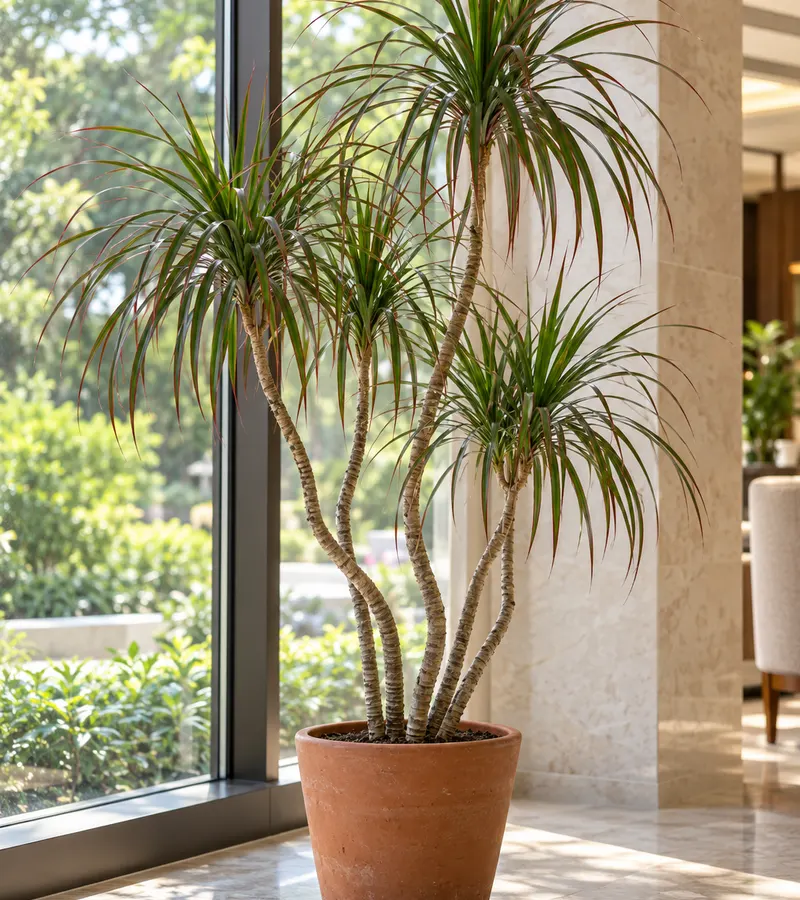
Slender, curving stems carry tufts of narrow red-edged leaves, suiting a lobby corner or a spot by a window.
Care and placement
Prefers bright indirect light and tolerates dimmer spots with slower growth; let the top 5 cm or so of mix dry before watering; use filtered or rain water because it is sensitive to fluoride; propagate with stem cuttings.
Draft mature dimensions
Maximum height (cm): 180 cm · Maximum spread (cm): 90 cm
Things to consider
ASPCA lists it as toxic to dogs and cats: vomiting (sometimes bloody), heavy drooling, loss of appetite, lethargy, and dilated pupils in cats. NC State Extension says it contains saponins and is mildly toxic to people too, with possible vomiting, mouth and stomach irritation and skin-irritating sap. Keep it away from small children and pets, and wear gloves when pruning.
Sources to cross-check
Kew Plants of the World Online · Dracaena marginataASPCA · Madagascar Dragon TreeNC State Extension Plant Toolbox · Madagascar dragon tree (listed as Dracaena reflexa var. angustifolia)Healthy Houseplants · Madagascar dragon tree (Dracaena marginata)Botanical Gardening · Dracaena marginata careKhám phá xanh · Cây phát tài núi (huyết giác Madagascar)How to grow and care for it
Planting and pot
Plant in a pot with drainage holes and a loose, well-drained mix. The tall, slim canes tip over easily, so choose a pot with a heavy or wide base, and avoid one much larger than the root ball, since mix that stays wet invites rot.
Light
Bright indirect light is best. Dim spots are survivable but growth slows, leaf colour fades and new tufts sit further apart; direct sun scorches pale patches into the leaves. A windowless room needs a full-spectrum grow light on for several hours a day; no source gives a specific lux figure.
Watering
Wait until the top 5 cm or more of mix is dry, then water until it runs from the bottom and empty the saucer; water less in cool weather or low light. It copes with dryness better than with soggy mix. Fluoride, chlorine and salts in tap water scorch leaf tips, so use filtered, distilled or rain water.
Feeding
Use a balanced water-soluble fertiliser at half the label strength, about every 4–6 weeks in the growing season, and reduce or stop when growth slows. Overfeeding leaves a white salt crust on the soil and burns leaf tips.
Pruning
To shorten the plant or make it branch, cut the top in one clean, slightly angled cut at the height you want with sharp, clean shears or a knife, ideally in spring or early summer. Two or more shoots usually appear below the cut within weeks to months. Remove yellow or damaged leaves at any time.
Propagation
Take stem cuttings 15–30 cm long with at least one node, let the cut dry for a day or two, then root in moist mix or water in bright indirect light at about 21–27 °C. Roots usually appear in 3–8 weeks; late spring to summer is the best time.
Pests and common problems
Spider mites, mealybugs, scale and thrips are the usual pests: wipe them off with an alcohol swab, then use insecticidal soap or neem oil every 7–10 days until clear. Brown tips come from fluoride, salts, overfeeding or dry air; leaves drop in cold below about 10 °C or in a direct blast from an air conditioner; waterlogging causes root rot.
For plentiful, healthy leaves
For fuller, richer foliage: give bright indirect light, water with filtered water, feed lightly by season and top the canes at the right time to get more branches. Too little light gives stretched stems and pale, sparse leaves.