
Corn plant
Dracaena fragrans
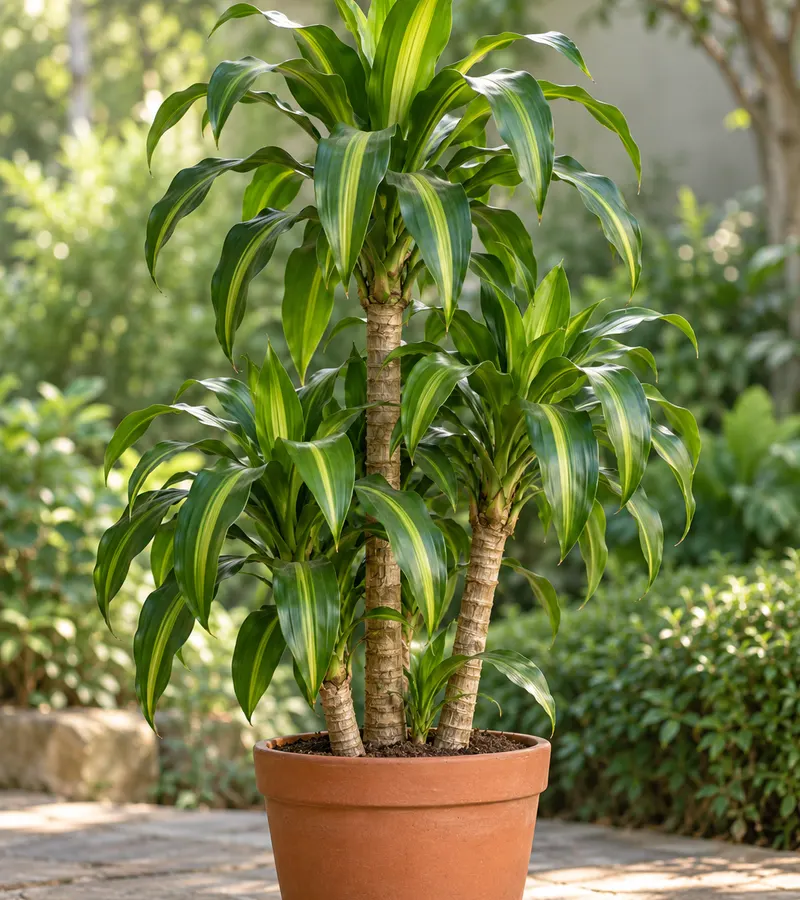
Upright canes and long glossy leaves add a vertical accent to a corner.
Care and placement
Tolerates low to bright indirect light, avoid harsh sun; very sensitive to tap-water fluoride so use filtered or rain water; water when the top 2–3 cm is dry.
Draft mature dimensions
Maximum height (cm): 150 cm · Maximum spread (cm): 80 cm
Things to consider
The genus Dracaena contains saponins: toxic to dogs and cats, causing vomiting (sometimes bloody), anorexia and drooling (ASPCA). Keep pets and children from chewing it.
How to grow and care for it
Planting and pot
Plant in a draining pot with a loose mix. Tall canes need a heavy, stable pot. Repot when roots fill the pot.
Light
Tolerates low to bright indirect light. Strong sun scorches leaves; dim light slows growth and fades striped forms.
Watering
In warm months water when the top 2–3 cm is dry; when cool wait until it is drier (about 5 cm). Overwatering rots roots and yellows leaves. Use filtered or rain water; letting tap water sit overnight removes chlorine but not fluoride.
Feeding
Balanced liquid fertilizer at half strength monthly in spring and summer (or once or twice a season for a lighter touch); reduce or stop in autumn and winter.
Pruning
Remove yellowing lower leaves with clean shears. The cane can be cut at any height; new growth sprouts from one or two points just below the cut. Prune in spring or summer.
Propagation
Cane cuttings: cut 10–15 cm sections, let the cut end callus for a few hours, plant about 5 cm deep in moist mix (rooting hormone optional); roots form in 3–4 weeks. Water rooting and air layering also work.
Pests and common problems
Crispy brown tips come from fluoride, dry air or excess fertilizer; overwatering causes root rot, yellowing and weak stems. Spider mites, mealybugs and scale can occur.
For plentiful, healthy leaves
For plentiful glossy leaves: use filtered water, give enough indirect light, feed lightly on schedule, and cut the top when tall so new shoots form. Scented flowers appear only on very large plants, rarely indoors.