
Longan
Dimocarpus longan
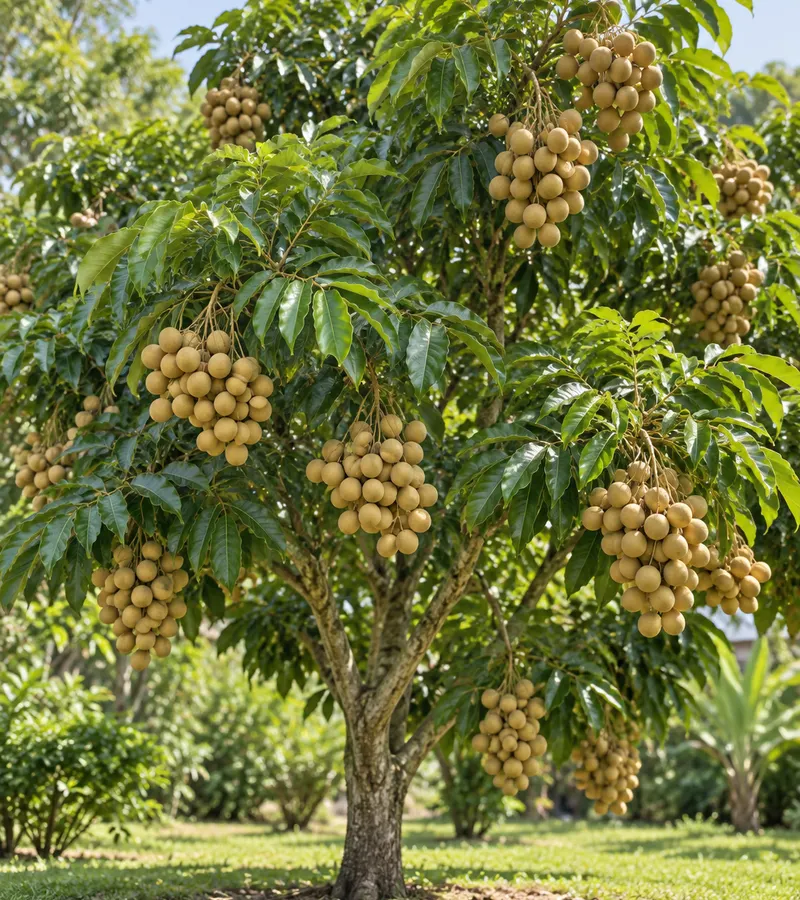
A medium round-crowned tree with clusters of thin brown-skinned fruit and sweet white flesh; it needs a cool season to flower.
Care and placement
It likes sun or part shade, with PFAF noting it prefers some shade from the strongest sun; well-drained soil, preferred pH 5.5–6, and plenty of moisture from fruit set to maturity (about 1,500–2,000 mm of rain a year). It needs a distinct cool season (up to 3 months, with virtually no frost) to bloom, and flowers poorly after a warm winter (PFAF). Wikipedia: it survives brief drops to about −2 °C, but young plants are more vulnerable.
Draft mature dimensions
Maximum height (cm): 1200 cm · Maximum spread (cm): 1200 cm
Things to consider
PFAF lists no known hazards, but no official toxicity rating exists for children, dogs or cats, so it is not claimed safe. The tree is large (PFAF: 12–14 m) and fruits in heavy clusters; the small slippery seeds are a choking risk for young children, so do not give them whole fruit with the seed (general practice; the sources do not say).
How to grow and care for it
Planting and pot
Choose a sunny, well-drained but moist spot; PFAF says it can reach about 12 m tall and wide. A layered tree fruits much sooner: PFAF says seedlings take 7–10 years and vegetatively propagated trees 3–5 years (air layers 2–3), so buy a layered or grafted tree.
Light
PFAF: it grows in part shade or none, and prefers some shade from the strongest sun. A young tree may want light midday shade, while a large tree needs sun to flower and fruit (our inference; the sources do not say).
Watering
PFAF: it prefers moist soil and needs abundant moisture from fruit set to maturity, suiting 1,500–2,000 mm of rain a year (800–3,000 mm tolerated), and succeeds on most fertile soils with enough moisture. Water evenly when dry and while fruit swells; do not let the soil waterlog (our inference).
Feeding
The sources give no feeding schedule. PFAF says it succeeds on fertile soil, so add well-rotted organic matter at planting and feed lightly to the label; avoid heavy nitrogen when you want it to flower (general practice; the sources do not say).
Pruning
The sources do not cover pruning. The tree grows fast (PFAF), so remove dead and crowded branches and keep a workable picking height; Wikipedia says whole clusters are cut with knives or scissors, so low branches make harvest easier.
Propagation
PFAF: mostly from seed, sown no more than 2 cm deep and germinating in 7–10 days; air layering (layers bear in 2–3 years) and grafting are also used. A seedling is slow (7–10 years) and may differ from its parent, so layering from a tree you like is the way to fruit sooner.
Pests and common problems
Wikipedia records witch's broom as the most prevalent disease, deforming the skin and causing early fruit drop; longan decline (mainly in Thailand), red-orange algal spot on leaves, Phytophthora palmivora causing brown spots and fruit drop, and stem-end rot. Cold hurts young trees. After a warm winter it may flower poorly (PFAF).
For heavy fruiting
For fruit: choose a layered tree with enough sun and moist but draining soil, and water evenly while fruit sets. PFAF: it needs a cool season to flower in mid-spring, so where winters are too warm fruit may be scarce. Wikipedia: pick early in the day to keep fruit fresh, and it stays fresher attached to the branch.