
Dumb cane
Dieffenbachia seguine
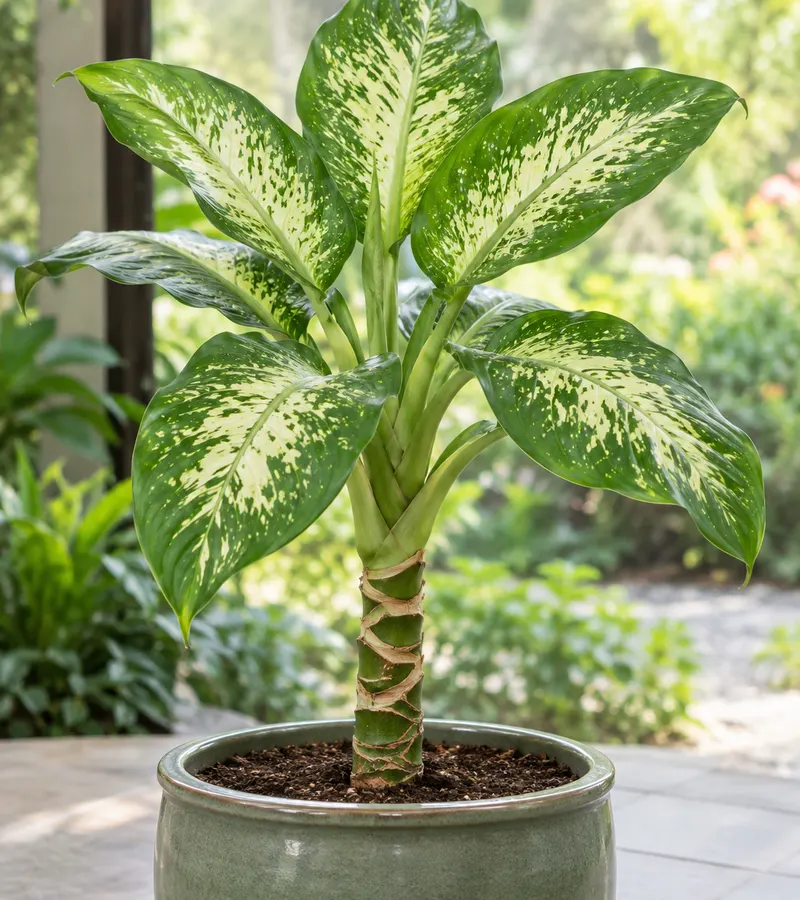
Large leaves splashed with cream on green, but the sap holds calcium oxalate crystals, so keep it away from children and pets.
Care and placement
Poisonous if eaten and the sap irritates, so keep it away from small children and pets. Prefers bright indirect light and tolerates dim spots with slower growth; water thoroughly then let the top 2.5 cm dry; keep the air humid; always wear gloves when pruning or taking cuttings.
Draft mature dimensions
Maximum height (cm): 150 cm · Maximum spread (cm): 70 cm
Things to consider
Every part (leaves, stems, roots, sap) contains calcium oxalate crystals and oxalic acid. Eating it causes burning pain, swelling of the lips, tongue and throat, difficulty speaking and swallowing, nausea, vomiting and diarrhoea; swelling of the throat can cause suffocation, so get emergency medical help at once. NC State rates the toxicity as high and says it may be fatal to livestock and pets; ASPCA lists it as toxic to dogs and cats. The sap causes contact dermatitis, and in the eyes it can damage the cornea. Do not grow it where small children or pets can reach it, wear gloves when touching it and wash your hands afterwards.
How to grow and care for it
Planting and pot
Wear gloves when potting or repotting because the sap irritates. Use a pot with drainage holes and a loose, humus-rich, well-draining mix, and repot in early spring. Put the pot where children and pets cannot reach it, since leaves up to about 45 cm long are easy to grab, bite or chew.
Light
Bright filtered or indirect light is best; harsh direct sun scorches the leaves. Dim spots and heavy shade are survivable but growth slows and the plant looks less good. A windowless room needs a grow light on through the day; no source gives a specific lux figure.
Watering
Water thoroughly, then let the top 2.5 cm or so of mix dry before watering again; watering too often rots the roots. It likes humid air, so keep it away from drying air-conditioner draughts and do not leave water standing in the saucer.
Feeding
Feed a liquid foliage-plant fertiliser at half strength about every 2–4 weeks while the plant is growing strongly, or use a slow-release feed as labelled. Too much fertiliser burns leaf margins. Wear gloves and wash your hands after touching the plant.
Pruning
Lower leaves drop naturally as the plant matures; when the stem gets long and bare, cut it back to about 15 cm and it will regrow below the cut. Always wear gloves, keep your hands away from your eyes, wash tools and hands afterwards, and dispose of the trimmings where children and pets cannot reach them.
Propagation
Propagate by cane cuttings, stem-tip cuttings or air layering in spring or early summer; NC State also lists division and root cuttings. Wear gloves and keep the sap off skin and eyes when cutting; let the cut dry before setting it in moist mix.
Pests and common problems
Common pests are spider mites, mealybugs and aphids; NC State also lists scale, whiteflies and fungus gnats. Root rot from wet mix, fungal leaf spots and leaf-margin burn from too much fertiliser are also common. If anyone eats the plant or gets sap in the eyes, go to a medical facility straight away; for a pet, contact a vet immediately.
For plentiful, healthy leaves
For big, clearly marked leaves: enough bright indirect light, humid air, even watering without waterlogging and light feeding by season. Grow it only where it can be kept out of reach of small children and pets.