
Noble dendrobium
Dendrobium nobile
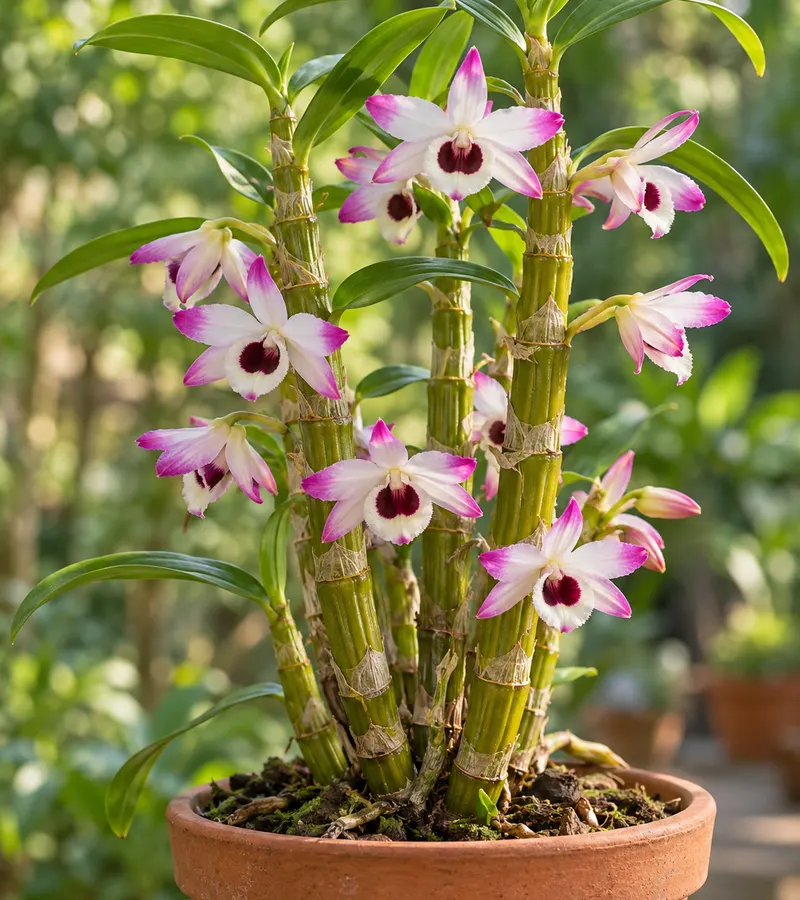
Flowers line slender canes at the end of the dry season, often hung on wood.
Care and placement
Needs bright indirect light (morning sun is good), soaking once or twice a week in the growing season and a dry, cool winter rest of 2–3 months to flower; light, regular feeding.
Draft mature dimensions
Maximum height (cm): 60 cm · Maximum spread (cm): 30 cm
Things to consider
ASPCA lists Dendrobium (e.g. leopard orchid) as non-toxic to dogs, cats and horses. Still discourage pets from chewing stems or leaves.
How to grow and care for it
Planting and pot
Use a small pot or hanging basket with an airy mix (bark, charcoal, tree fern); it likes being slightly snug; repot in spring after flowering when the mix decays.
Light
Bright indirect light; deep lush green leaves mean too little light, olive to yellow-green is right, pale or red-tinged leaves mean too much sun. Morning sun is beneficial; east-facing spots work well.
Watering
In the growing season soak then drain fully, about every 3–7 days depending on conditions. From about mid-November give a rest: almost no water for 2–3 months, just enough that canes do not shrivel, with nights around 10–13 °C for 4–8 weeks. Newer hybrids are easier and can be watered all year.
Feeding
Feed weakly and often while canes grow; excess nitrogen gives leaves and keikis instead of flowers; stop once canes finish growing.
Pruning
Do not cut green canes since old canes keep flowering for years; only remove fully dead, dry canes at the base.
Propagation
Spring to early summer: separate rooted keikis or divide back-bulbs; pot in fresh bark mix, water lightly and keep warm, bright and humid; a loose plastic bag over the pot helps in the first week.
Pests and common problems
Plants that grow leaves without flowering usually had a winter that was too warm and wet; excess water or fertilizer and warm nights in the rest period turn flower nodes into keikis. (The sources checked give no specific pest data; watch for mealybugs, scale and spider mites.)
For more flowers
For many flowers along the canes: enough light, a proper dry cool winter rest of 2–3 months, light feeding while canes grow and a clear seasonal change. Flowers open in late winter to early spring.