
Rangoon creeper
Combretum indicum
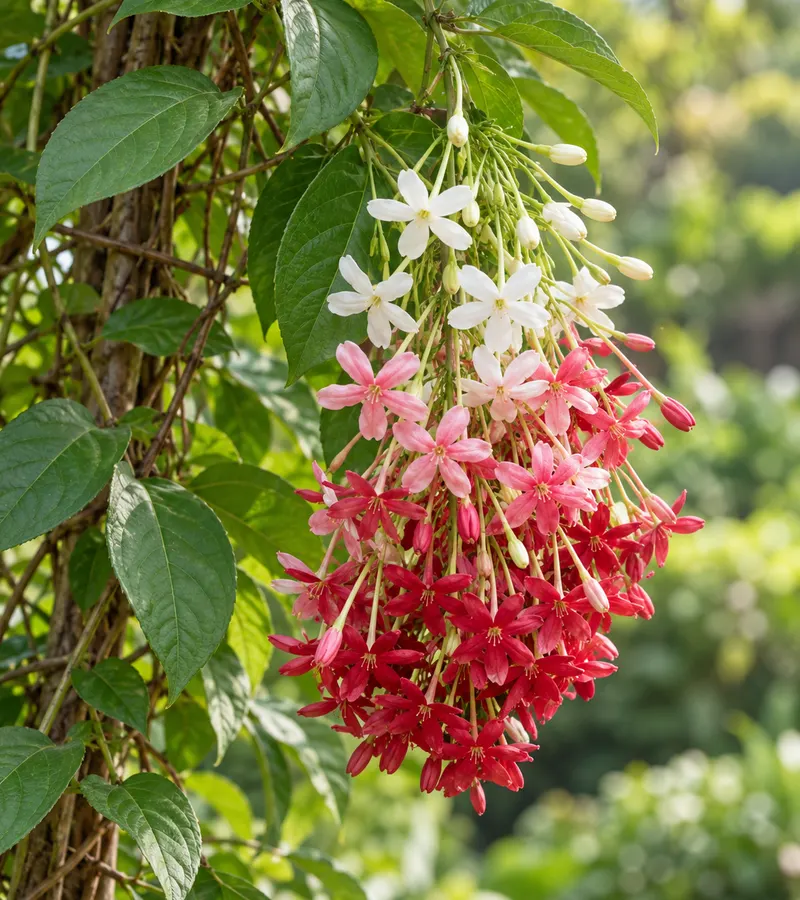
Flowers shift from white to pink then red within the same cluster.
Care and placement
Needs at least 6 hours of sun to flower, a very strong support (climbs 6–12 m), moderate watering and fertile, well-drained soil; flowers change from white to pink to red.
Draft mature dimensions
Maximum height (cm): 600 cm · Maximum spread (cm): 300 cm
Things to consider
The seeds (and those of related Quisqualis species) contain quisqualic acid; large amounts can cause hiccups, nausea and diarrhea (Wikipedia); flowers and foliage are not reported as toxic. Do not self-dose seeds as a dewormer; keep seeds from children and pets.
How to grow and care for it
Planting and pot
Plant in sun in fertile, well-drained soil; provide a very strong trellis, fence or arbor because the vine is long and heavy. A large pot works in cooler regions.
Light
Full sun to part shade; at least 6 hours of direct sun for good flowering.
Watering
Moderate watering: more when hot, less when cool; let the surface dry slightly between waterings.
Feeding
Avoid nitrogen-rich fertilizer in the flowering season since it favours leaves over flowers; a light balanced or phosphorus/potassium feed early in the season is better.
Pruning
Prune regularly after flowering to keep it in check; it can sucker from the roots, so remove suckers away from the main plant.
Propagation
Cuttings of healthy stems with several nodes, lower leaves removed, in moist mix in bright indirect light (can be hard to root if done wrongly); or root suckers, or seed (fruiting is rare).
Pests and common problems
Few pests or diseases are reported; the main issue is its aggressive growth and root suckering. It loses its leaves at the lightest frost.
For more flowers
For many flower clusters: full sun, a strong support, low nitrogen, pruning after flowering and moderate watering. Fragrant flowers open progressively and change colour within one cluster.