
Camphor tree
Cinnamomum camphora
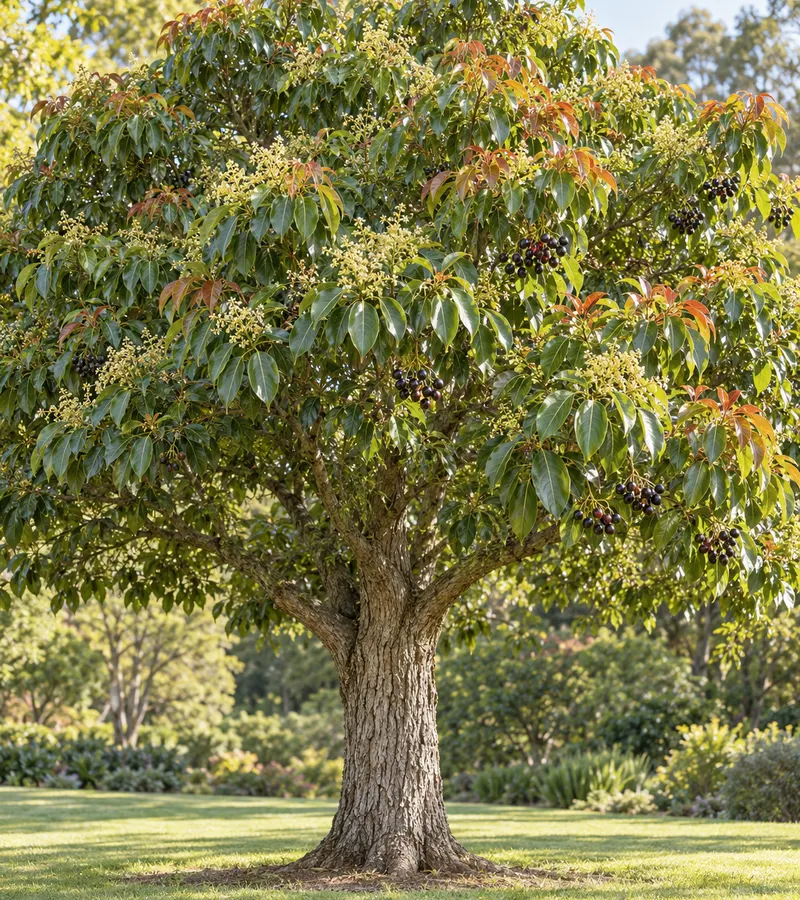
A broad evergreen round crown whose crushed leaves smell strongly of camphor, often planted as a city shade tree.
Care and placement
Needs full sun to partial shade and well-drained soil (drought tolerant once established, no tolerance for waterlogging), with pruning to build a strong branch frame; a tree with a 15–20 m spread and surface roots needs a roomy site well away from pavements and pipes; propagated by fresh seed.
Draft mature dimensions
Maximum height (cm): 1400 cm · Maximum spread (cm): 1800 cm
Things to consider
The tree contains camphor oil: sources say the plant is poisonous in large amounts, large doses of the oil can cause respiratory failure in children, and the oil and wood may irritate eyes and skin. Do not eat leaves, fruit or oil; keep children and pets from chewing it and wear gloves when pruning. The small black fruits drop on pavements and cars and the seedlings spread when birds carry the seed; in places such as Florida and Australia the tree is treated as invasive. Planting or pruning on public land needs the authority's permission.
Sources to cross-check
Kew Plants of the World Online · Cinnamomum camphoraUF/IFAS EDIS · Cinnamomum camphora: Camphor-TreeNC State Extension Plant Toolbox · Cinnamomum camphoraPlants For A Future · Cinnamomum camphoraUseful Tropical Plants · Cinnamomum camphoraNParks Flora & Fauna Web · Cinnamomum camphoraWikipedia tiếng Việt · Long não (cây)Chính phủ · Nghị định 64/2010/NĐ-CP về quản lý cây xanh đô thịHow to grow and care for it
Planting and pot
A typical tree is 12–15 m tall with a 15–21 m spread and may have large surface roots, so plant it only where there is room; distances to buildings, pavements, pipes and overhead lines need a site survey, and the decree requires the electricity safety corridor to be kept. Do not plant over parking, because the fruit stains cars, and avoid sites near natural forest or scrub because birds spread the seed. Choose well-drained soil; the decree restricts trees whose strong smell affects the environment, so ask the authority whether it may be planted on a pavement.
Light
Plant in full sun for a dense crown; it also tolerates partial sun or partial shade. Unshaded trees have the highest oil content, and one source advises sheltering new spring growth from early morning sun.
Watering
The tree is drought tolerant once established, so it needs only regular watering in the first year and the dry season. Do not let the soil stay wet, because the roots rot easily, especially in poorly drained soil; high rainfall suits it only where drainage is good.
Feeding
The sources consulted give no specific fertiliser schedule. On alkaline soil the tree often shows minor-element deficiencies, in which case a micronutrient feed can help; otherwise mix well-rotted compost in at planting and mulch.
Pruning
Prune young trees to a single main trunk with major branches spaced about 45–75 cm apart along it; avoid several major branches from the same point or an upright multi-trunk form. The tree is rated resistant to breakage, but periodic pruning still keeps a strong frame. Pruning on public land, especially trees 10 m or taller, needs a permit under the decree.
Propagation
Propagate by seed: it loses viability quickly, so sow it as soon as it ripens and remove the fruit pulp, which can inhibit germination; seed germinates in 1–6 months at 20 °C. Semi-ripe cuttings about 7 cm long with a heel can be rooted in June or July with bottom heat. Seed germinates readily in the landscape, so pull out volunteer seedlings.
Pests and common problems
Scales and mites are common; poorly drained soil causes root rot, and the tree is susceptible to Verticillium wilt and, in the US, laurel wilt. In a city watch for large surface roots near pavements or pipes, small black fruit that dirties walks and cars, a strong camphor smell when leaves are crushed, and spread by birds carrying the seed. The sources consulted do not report allergenic pollen. The roots are very sensitive to disturbance, so avoid digging near the base during works.
For plentiful, healthy leaves
For a dense glossy crown: plant in full sun in well-drained soil, water steadily in the first year then let the tree handle dry spells, and shape the frame early. The glossy camphor-scented leaves and rusty-red new growth are its best features.