
Florist's chrysanthemum
Chrysanthemum × morifolium
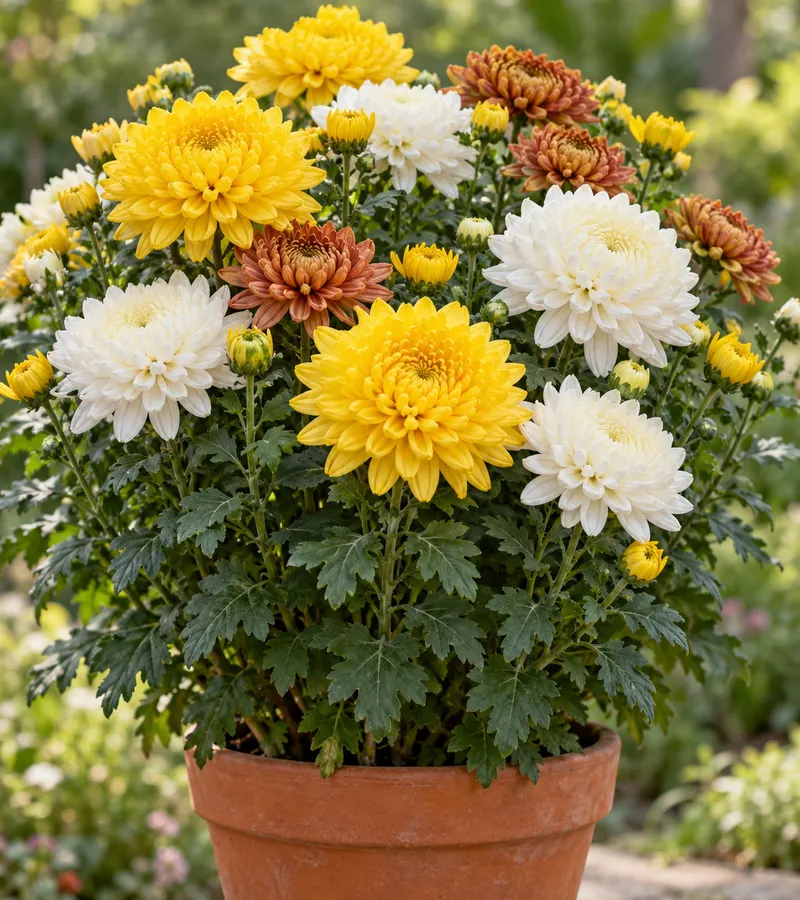
Many forms and colours that peak toward year-end, familiar for festive seasons.
Care and placement
Needs at least 6 hours of sun, shallow roots so water evenly at the base, pinching until mid-season; flowers on short days (nights longer than about 9–10 hours).
Draft mature dimensions
Maximum height (cm): 80 cm · Maximum spread (cm): 50 cm
Things to consider
Chrysanthemum contains sesquiterpene lactones and pyrethrins: ASPCA lists it as toxic to dogs, cats and horses (vomiting, diarrhea, drooling, incoordination, dermatitis); NC State rates it low severity. Keep pets from chewing it; do not self-medicate.
How to grow and care for it
Planting and pot
Plant in sun in well-drained, humus-rich soil; use a wide pot with drainage holes. Space for airflow and mulch in summer to keep roots cool.
Light
At least 6 hours of direct sun to stay compact and set many buds; light late-afternoon protection helps in hot climates. Avoid planting near night lights since artificial light disrupts day length and inhibits flowering.
Watering
Shallow roots need frequent watering: water when the top 2–3 cm is dry, at the base, avoiding overhead watering to limit fungus; mulch to cut evaporation.
Feeding
Balanced 10-10-10 at half strength monthly from early growth to mid-season, then stop so buds can form (or stop once buds show colour). Too much nitrogen gives lush leaves, fewer flowers and weak stems.
Pruning
Pinch tips at 15–20 cm to branch and stop around mid-season so buds can form (last pinch about 100 days before the first expected frost in temperate regions). For exhibition-size blooms, remove side buds so one large flower develops.
Propagation
Tip cuttings of 8–10 cm in spring with lower leaves removed in moist mix; or divide established clumps every 2–3 years to keep them vigorous.
Pests and common problems
Aphids cluster on shoots and buds (rinse off, insecticidal soap); spider mites in hot dry weather; powdery mildew in humid, poorly ventilated spots; also botrytis, downy mildew, leaf spot and nematodes.
For more flowers
For more flowers: enough sun, correctly timed pinching, stop feeding as buds form, base watering, good airflow and natural short-day flowering (no night lighting).