
Night-blooming jasmine
Cestrum nocturnum
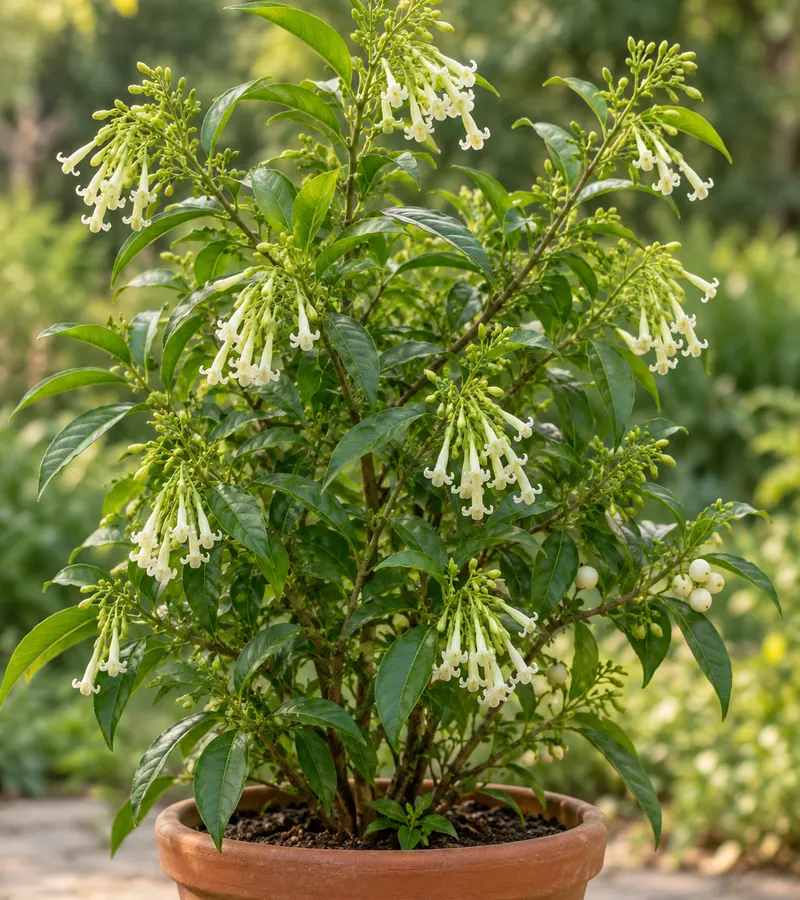
Small greenish flowers release strong scent at night; berries and leaves are toxic.
Care and placement
Needs full sun (6–8 hours) for the most flowers, moist but draining soil and a hard prune after flowering; flowers release strong scent at night; berries and leaves are toxic.
Draft mature dimensions
Maximum height (cm): 250 cm · Maximum spread (cm): 150 cm
Things to consider
A member of the nightshade family (Solanaceae) containing solanine-type alkaloids, also called 'poisonberry'; reports on foliage and fruit toxicity are mixed but it should be treated as poisonous (Wikipedia). The berries are the main hazard; people with asthma or sensitivities may get breathing difficulty, headache or nausea from the strong night scent. Keep it away from bedrooms, children and pets; it is not a true jasmine.
How to grow and care for it
Planting and pot
Plant in sun in humus-rich, well-drained soil; use a large pot with drainage holes. Leave room since it grows 1–4 m; avoid planting near bedroom windows because the scent is very strong.
Light
Full sun for the most flowers and sturdy growth (about 6–8 hours); tolerates part shade with fewer blooms. Afternoon shade helps in very hot places.
Watering
Water regularly, keeping soil moist but not waterlogged; more in dry spells and for pots; cut back sharply when cool. Overwatering causes root rot.
Feeding
Feed in early spring then every 4–6 weeks in the growing season with a balanced water-soluble fertilizer; if growth is strong, two feeds a season may do.
Pruning
Cut back hard after flowering and pinch tips to keep it compact; remove dead branches and spent flowers regularly. Pruning also limits bird spread of the berry seeds. Wear gloves.
Propagation
Take 10–15 cm cuttings from healthy stems in spring or summer: strip lower leaves and set in draining mix (rooting hormone optional) or root in water then move to soil. Seed from berries also works (toxic; wear gloves).
Pests and common problems
Spider mites, aphids and whiteflies; root rot if waterlogged. In frost-free regions it can turn weedy as birds spread the berries.
For more flowers
For plenty of fragrant flowers: enough sun, even watering, scheduled feeding (one source says seaweed or fish liquid feed every two weeks can boost bloom), a hard prune after each flush and deadheading.