
Golden shower tree
Cassia fistula
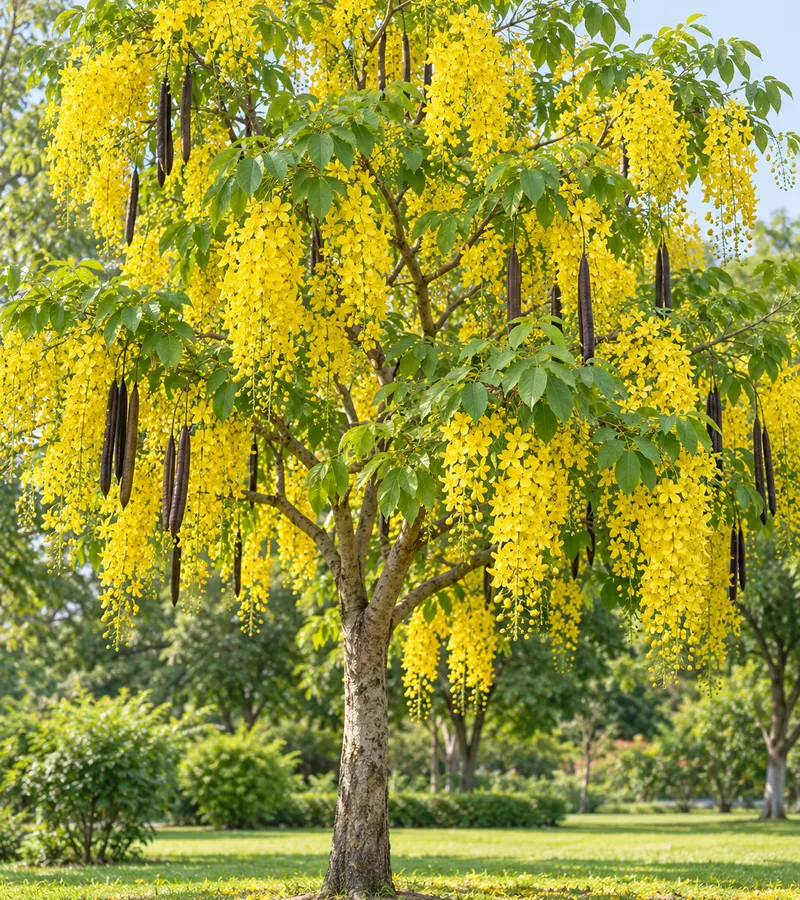
Long pendulous clusters of yellow flowers bloom in summer, followed by long cylindrical pods hanging from the branches.
Care and placement
Needs full sun and well-drained soil; moderately drought tolerant but frost tender; shape the crown while young and propagate from seed after breaking the hard seed coat.
Draft mature dimensions
Maximum height (cm): 1000 cm · Maximum spread (cm): 1000 cm
Things to consider
UF/IFAS lists the seeds as poisonous and PFAF says every part is poisonous if eaten; the pod pulp is a strong purgative, so do not eat it or use it as medicine. The long pods drop onto pavements and yards and smell pungent, so keep children and pets from picking up or chewing pods and seeds.
How to grow and care for it
Planting and pot
Choose a spot in full sun with good drainage, since root rot is a recorded disease of this tree. A mature tree is about 9–12 m tall and wide (UF/IFAS), so it needs room; the distance from buildings, buried pipes, pavements and overhead lines has to come from a site survey because the sources give no general figure. UF/IFAS says roots are not a problem and lists it for tree lawns 4–6 ft (about 1.2–1.8 m) wide, but a canopy that size still does not belong in a very cramped spot. Planting on public land such as pavements, parks or medians needs permission from the tree authority or the land owner. It suits hot climates and is frost tender (UF/IFAS gives only USDA zones 10B–11), so it is not for cold highlands.
Light
Needs full sun to flower well; UF/IFAS and PFAF both list it as a sun lover. Young plants can be given light shade at first (the Vietnamese Wikipedia says young plants prefer light shade). It blooms better where summer and winter temperatures differ clearly (Wikipedia) and is damaged by temperatures only slightly below freezing (UF/IFAS).
Watering
It is moderately to fairly drought tolerant once established (UF/IFAS, PFAF) but prefers moist soil. Water regularly until it is established, then only top up in long dry spells. Avoid standing water, since root rot is a recorded disease, especially in the rainy season.
Feeding
The sources give no specific fertiliser rates, so feed lightly: rotted organic matter spread around the edge of the canopy at the start of the rainy season, especially for young trees or poor soil. It grows in sand, loam and clay if drainage is good (UF/IFAS), so it rarely needs heavy feeding. Do not pile fertiliser against the trunk, where young roots can burn.
Pruning
UF/IFAS advises occasional pruning while the tree is young to build an even crown, plus staking and proper pruning because young trees often grow lopsided with drooping branches. Prune after the flowers fade so you do not remove the blooms. For roadside trees, lifting the crown for clearance and keeping away from power lines should be left to licensed pruning crews rather than done by climbing near the wires.
Propagation
Propagate by seed; the seed coat is hard, so nick or abrade it or soak the seed in warm water for 12–24 hours before sowing in full light (PFAF). Seed-grown trees take about 8–10 years to flower, and vegetative propagation can shorten that. Half-ripe wood cuttings are another option.
Pests and common problems
Common pests and diseases are leaf-eating caterpillars, mildew, leaf spot and root rot (UF/IFAS), plus stem borers (Vietnamese Wikipedia). In a city, the 30–60 cm pods fall and sit on the ground for a long time, leaves also drop for a short period and regrow, and the pods smell pungent. UF/IFAS rates the wood as breakage resistant but young trees grow lopsided and need staking, while PFAF says it tolerates strong wind but not maritime exposure, so be careful near the coast. It can send up root suckers (PFAF). The sources say nothing about allergenic pollen.
For more flowers
For more flowers: give full sun, good drainage and moderate water, prune after the blooms fade and be patient, since seed-grown trees take 8–10 years to flower (PFAF). The yellow flowers hang in clusters 20–40 cm long, each 4–7 cm across, opening around May to July in the northern hemisphere.