
Indian shot
Canna indica
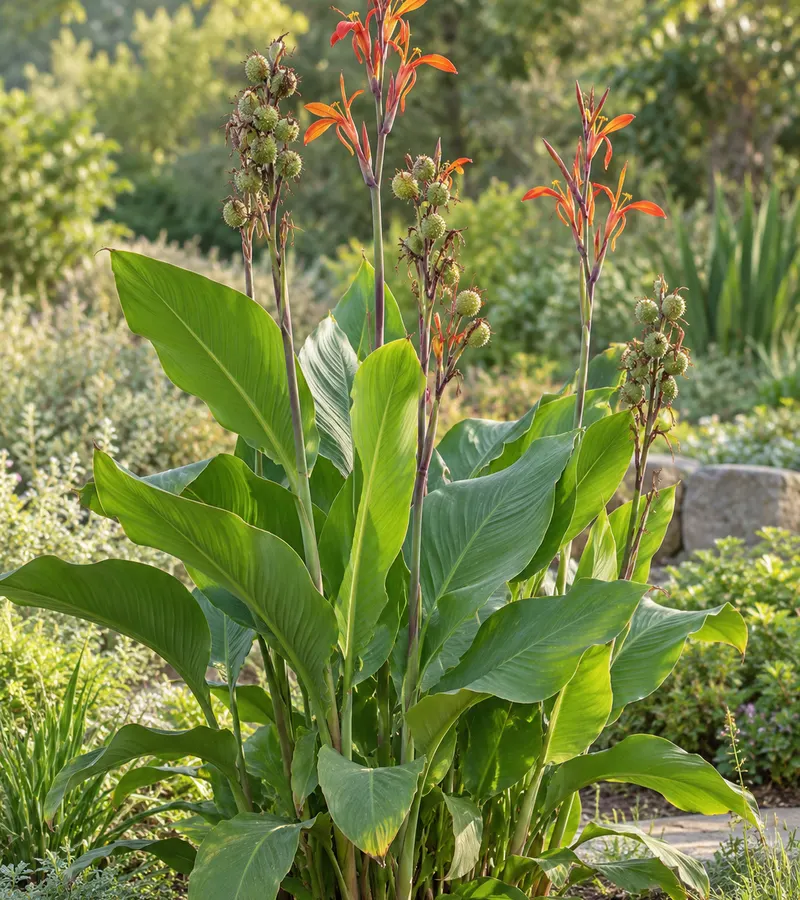
Banana-like leaves and upright orange-red flowers, easy to grow along a fence.
Care and placement
Needs at least 6 hours of sun, about 25 mm of water a week (pots every 2–3 days in summer), well-drained soil and plenty of potassium; divide rhizomes in spring.
Draft mature dimensions
Maximum height (cm): 150 cm · Maximum spread (cm): 80 cm
Things to consider
ASPCA lists Canna indica as non-toxic to dogs, cats and horses. The starchy rhizomes are eaten in some regions but should not be eaten without proper knowledge.
How to grow and care for it
Planting and pot
Plant rhizomes (each piece with prominent eyes) 5–10 cm deep in sun in humus-rich, well-drained soil; use a large pot with drainage holes. Space for airflow.
Light
Full sun, at least 6 hours of direct sun daily; part shade is tolerated but flowering drops.
Watering
Keep soil evenly moist, never waterlogged: about 25 mm of water a week in active growth; pots may need water every 2–3 days in summer. Poor drainage rots the rhizomes.
Feeding
A heavy feeder: high-potassium feed (RHS: every 2–3 weeks in the growing season) or a rose/tomato fertilizer not too high in nitrogen every 2–4 weeks; or a balanced slow-release every 4–6 weeks.
Pruning
Deadhead to prolong flowering; removing seed pods can give a second flush; after flowering cut stalks to the ground to induce new growth.
Propagation
Divide rhizomes in spring: cut into pieces with prominent eyes using a clean, sharp knife to avoid disease spread, then plant at once. Seed also works (hard-coated; soak or nick the coat).
Pests and common problems
Canna leaf-roller caterpillars (Bt or an insecticide if needed), slugs and snails, caterpillars and spider mites; rust, leaf spot and bacterial blight. Remove diseased leaves and keep airflow.
For more flowers
For many flowers: full sun, plenty of water and potassium, deadheading and removing pods, and dividing crowded rhizomes. Red-orange flowers sit on upright stems with banana-like leaves.