
Bougainvillea
Bougainvillea glabra
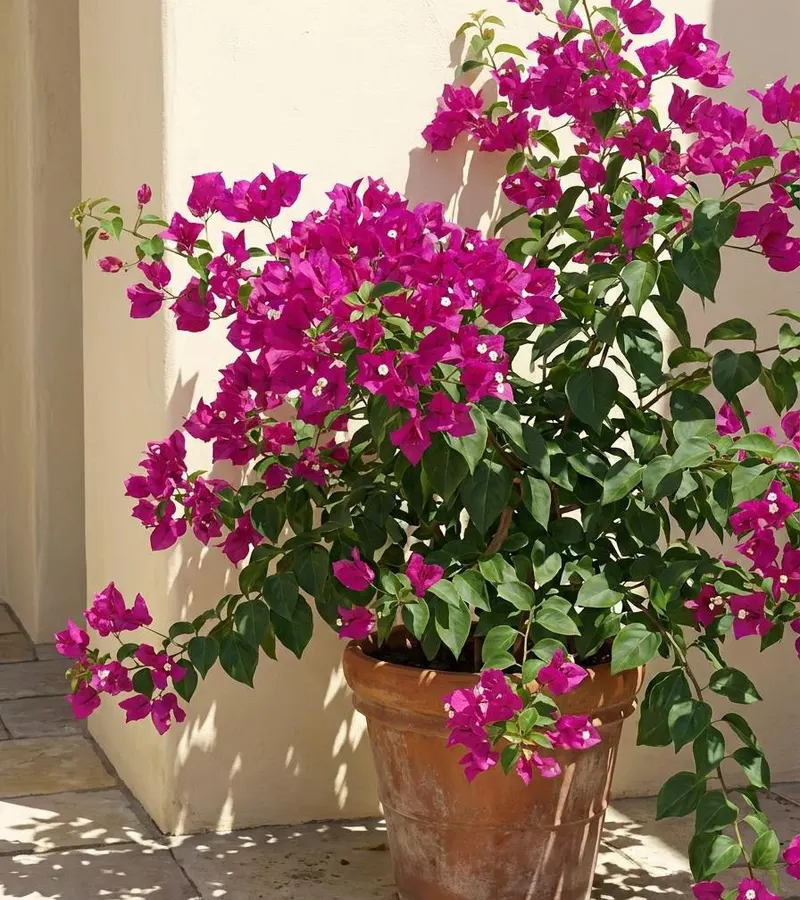
A vivid accent for ideas around sunny balconies and courtyards.
Care and placement
Needs full sun (6–8 hours), a fast-draining mix, deep watering then drying out; a slightly pot-bound, mildly dry-stressed plant bears the most bracts; thorns are curved.
Draft mature dimensions
Maximum height (cm): 400 cm · Maximum spread (cm): 300 cm
Things to consider
NC State Plant Toolbox does not flag Bougainvillea as poisonous, though that is not absolute proof of safety; the curved 2.5–5 cm thorns can injure. Wear thick gloves when pruning and site it away from paths and children.
How to grow and care for it
Planting and pot
Plant in sun in fast-draining soil (sandy loam with perlite or coarse sand) in pots with drainage holes. Do not rush into a bigger pot since it flowers best slightly root-bound. Provide a trellis or post to tie to.
Light
At least 6–8 hours of direct sun; light afternoon shade is acceptable in very hot places. Dense shade weakens it and cuts flowering. Acclimatise over about a week when moving from low light to harsh sun to avoid bleaching.
Watering
Drought-tolerant and blooms under mild water stress: let the mix dry 5–7 cm down before a deep watering. Overwatering causes root rot.
Feeding
Low-nitrogen feed every 4–6 weeks from spring to late summer; stop in autumn and winter. Excess nitrogen gives leaves instead of bracts.
Pruning
Prune hard after each bloom cycle to force flower-bearing new wood (or do the main pruning in late winter to early spring, per source); remove dead and crossing stems and thin congestion. Wear thick gloves because of the thorns.
Propagation
Semi-ripe cuttings 8–12 cm from non-flowering shoots in late spring to summer: strip lower leaves, lightly wound the base, dip in rooting hormone and set in a sharply drained mix (50% perlite, 50% coarse sand or fine bark); keep warm and humid.
Pests and common problems
Bougainvillea looper caterpillars (hand-pick at night, prune heavily infested shoots); aphids, spider mites, mealybugs and whiteflies cause speckling, webbing and sticky residue — improve airflow and use insecticidal soap or neem. Root rot if overwatered.
For more flowers
For a blaze of bracts: maximum sun, sparing water so it stays slightly dry, a snug pot, low-nitrogen feeding and pruning after each flush. Holding back on water and fertilizer is the most effective trigger.