
Wax begonia
Begonia cucullata
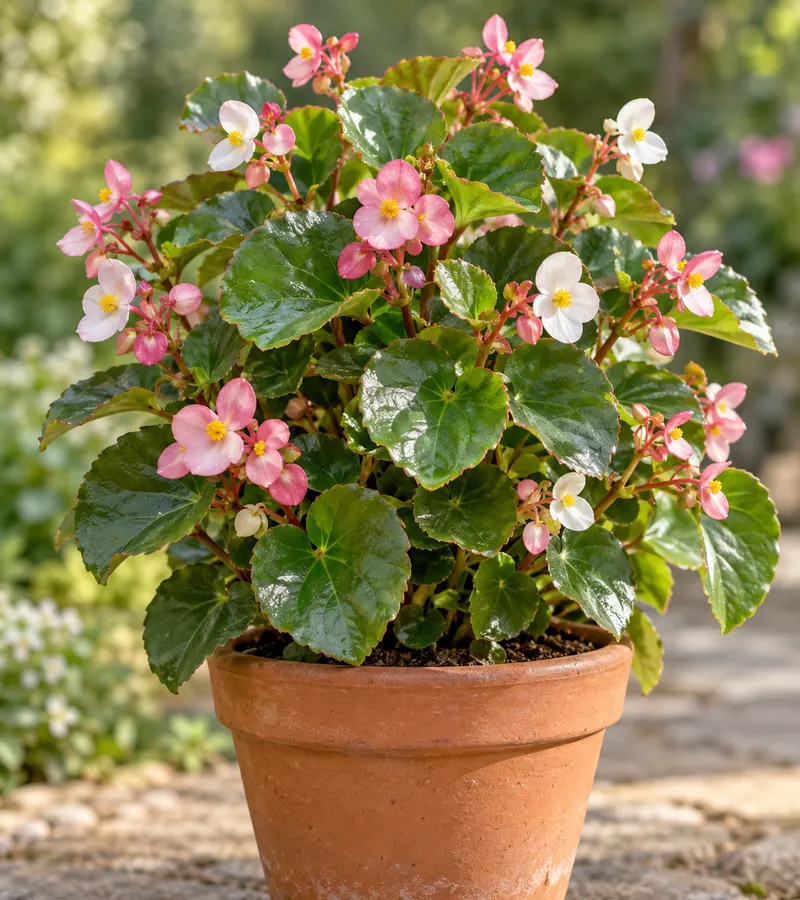
Glossy leaves and small pink, white or red flowers almost year-round.
Care and placement
Tolerates full sun to shade (best with morning sun and afternoon shade in hot places), water at the base in well-drained soil, balanced feed every 2–4 weeks; small flowers nearly year-round.
Draft mature dimensions
Maximum height (cm): 30 cm · Maximum spread (cm): 30 cm
Things to consider
Begonia contains soluble calcium oxalates: ASPCA lists it as toxic to dogs, cats and horses (vomiting, salivation; kidney failure in grazing animals); the tubers and roots are most toxic. Keep pets and children from chewing it.
How to grow and care for it
Planting and pot
Plant in pots or beds with loose, well-drained, humus-rich soil; pots need drainage holes. It can go in full sun to shade; indoors it needs bright indirect light.
Light
Tolerates full sun, part shade and even shade; in hot regions best with morning sun and dappled afternoon shade (about 4–6 hours of sun); indoors bright indirect light.
Watering
Water at the base to keep foliage dry and limit fungus; water until it drains, then wait until the top 2–3 cm is dry; moderately drought-tolerant once established.
Feeding
10-10-10 liquid fertilizer every 2–4 weeks in the growing season, or slow-release at planting then half-strength liquid every 2–3 weeks.
Pruning
Snip off about 2.5 cm of the stem tip just above a set of leaves so it grows two new stems and bushes out; deadhead to encourage more flowers.
Propagation
Cuttings 8–10 cm long, lower half stripped and 2–3 leaves kept at the top; rooting hormone is optional; root in water (change every few days) or moist mix in bright indirect light. Leaf cuttings or division also work.
Pests and common problems
Aphids, mealybugs and spider mites (mealybugs: insecticidal soap or alcohol swabs); powdery mildew and botrytis; overwatering causes root rot.
For more flowers
For many flowers: enough light, early pinching, deadheading, regular feeding in the growing season and base watering.