
Hong Kong orchid tree
Bauhinia × blakeana
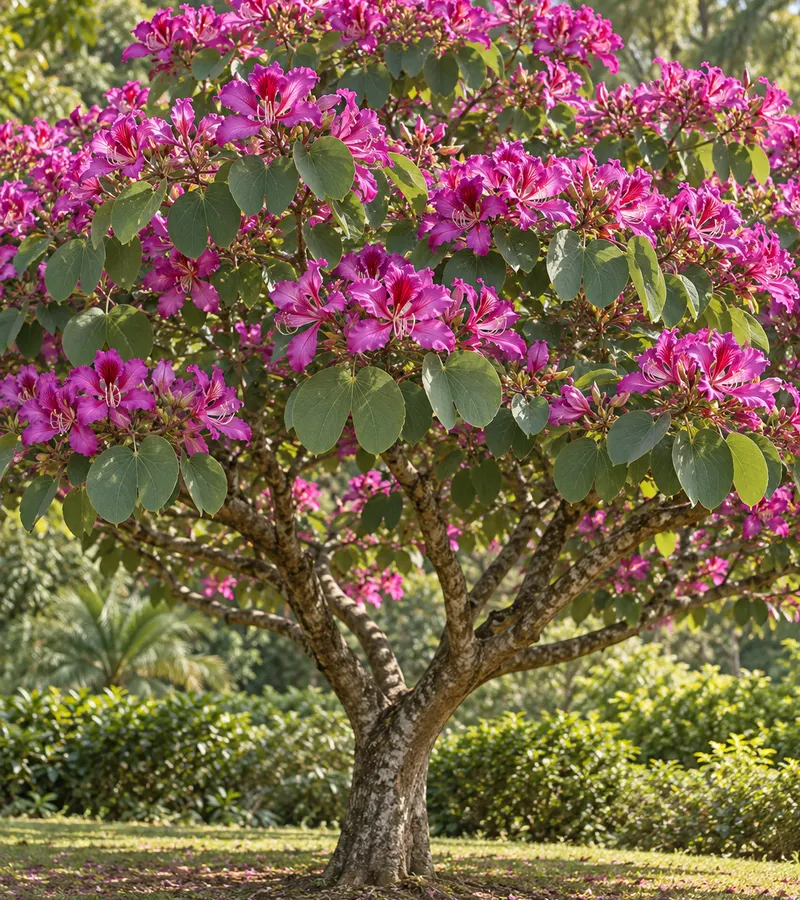
A sterile hybrid with large, fragrant purplish-pink flowers over a long cool-season bloom, suited to streets without strong wind.
Care and placement
Needs full sun and fertile, well-drained, slightly acidic soil, with moderate watering (very drought tolerant once established); avoid windy sites because the wood is brittle; propagated by grafting since the hybrid is sterile.
Draft mature dimensions
Maximum height (cm): 800 cm · Maximum spread (cm): 700 cm
Things to consider
The sources do not state any toxicity for this tree, so it is not claimed safe or toxic. The main city risk is its relatively brittle wood: branches may break in strong wind, so avoid busy spots right under the crown during storms. Do not eat it or use it as medicine; wear gloves when pruning.
How to grow and care for it
Planting and pot
Pick an open, sunny spot with little strong wind, because the tree reaches about 6–10 m, spreads roughly 6–7 m and has fairly brittle wood. The sources give no safe distance from buildings, pipes, pavements or overhead lines, so a site survey is needed before planting. It has a taproot plus fibrous roots; dig a hole sized to the root ball in well-drained soil and water well after planting. Planting on a pavement or public land needs permission from the landowner or the tree authority.
Light
Needs full sun. It is poor in the cold: frost or cold wind damages it, one source reports damage when nights fall to about −4 °C, so it does not suit high mountain areas with frost.
Watering
Water moderately while young; once established it is very drought tolerant. Stop watering during long rainy spells and avoid waterlogging, which invites root rot.
Feeding
It likes fertile, slightly acidic soil; alkaline soil can cause yellow leaves with green veins. Feed with organic fertiliser and NPK a few times a year, which Vietnamese nurseries time as nitrogen and NPK early in the growing season and organic fertiliser with potash in the rainy season.
Pruning
Prune for good form and remove crossing branches; prune after flowering if needed. Vietnamese nurseries advise regularly removing low shoots, dead or diseased branches and vigorous upright shoots. Because the wood is brittle, deal with weak or crossing branches while they are small.
Propagation
This is a sterile hybrid, so it almost never sets seed; it is propagated by grafting, while cuttings and air layering also work but are not easy. Nearly every tree today is a clone of one original found in Hong Kong around 1880.
Pests and common problems
In the city: the tree is sterile so it drops no long pods, but leaves and flowers still fall; the wood is brittle, so avoid windy, coastal or typhoon-prone sites; the flowers are fragrant and the sources say nothing about pollen allergy. Aphids and fungi are the pests nurseries mention, so inspect before flowering. Because all trees are one clone, they could be open to a shared epidemic, though no major disease has appeared so far.
For more flowers
For more flowers: give full sun and fertile, well-drained soil, and avoid waterlogging and cold wind. The large fragrant purplish-pink flowers open from early November to the end of March in Hong Kong; in Singapore, where seasons are barely marked, the bloom is not as clear-cut.