
Bird's nest fern
Asplenium nidus
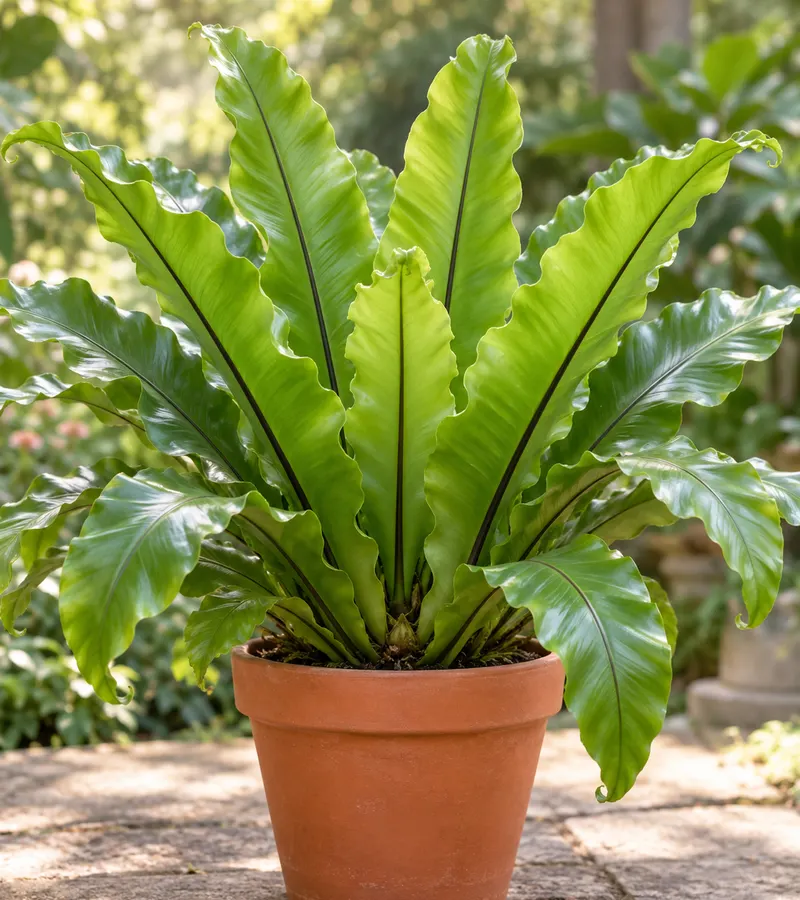
Whole, wavy glossy fronds form a nest-like rosette of striking shape.
Care and placement
Prefers bright indirect light, 60–80% humidity and 15–27 °C; water around the rim, not into the centre; frost-sensitive.
Draft mature dimensions
Maximum height (cm): 80 cm · Maximum spread (cm): 80 cm
Things to consider
ASPCA lists Asplenium species (e.g. hen-and-chickens fern) as non-toxic to dogs and cats. Still discourage pets from chewing large amounts.
How to grow and care for it
Planting and pot
Use an airy mix of peat, perlite and orchid bark (or mount it like an epiphyte). Pot with drainage holes; do not bury the centre of the rosette.
Light
Bright indirect light; east or north windows suit it. Direct sun damages the fragile fronds; add a grow light if natural light is too low.
Watering
Water when the top 2–3 cm is dry with free drainage, never letting it dry out fully. Water around the rim or from below, not into the rosette, to prevent crown rot. Use filtered or rain water if tap water browns edges. Keep humidity at 60–80% with a humidifier or grouped plants.
Feeding
Feed lightly: balanced fertilizer at 1/4–1/2 strength every 4–6 weeks in the growing season on already-moist mix; none when cool, and never into the centre.
Pruning
Only cut old, dry or damaged fronds near the base; avoid injuring the centre.
Propagation
Propagated by spores (slow, needs patience) or by division when it forms multiple crowns; it usually has a single crown so division is difficult. Pot divisions in fresh mix, water well and keep humidity high.
Pests and common problems
Brown crispy edges come from low humidity, fluoride/chlorine in water or excess fertilizer; a black mushy centre is crown rot (usually fatal); yellow lower fronds with soggy soil mean overwatering. Spider mites, mealybugs and scale: insecticidal soap or 1:1 isopropyl alcohol on a cotton swab.
For plentiful, healthy leaves
For a large, glossy, even rosette: high humidity, steady bright indirect light, clean water, light feeding and a dry centre. Ferns do not flower or fruit.