
Cast-iron plant
Aspidistra elatior
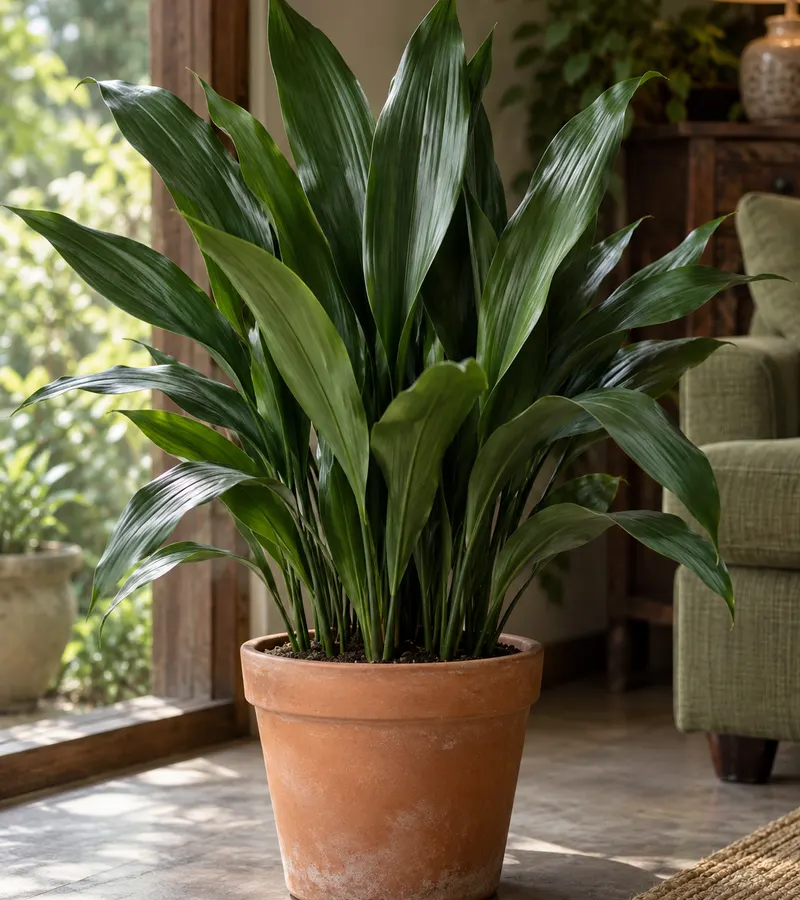
Glossy dark green leaves rise straight from a creeping rhizome and keep their colour in a dim corner.
Care and placement
Prefers partial to full shade and cannot take direct sun; water once the soil is dry about 5–7 cm down; slow-growing, so it rarely needs repotting; propagate by dividing the clump in spring or early summer.
Draft mature dimensions
Maximum height (cm): 60 cm · Maximum spread (cm): 50 cm
Things to consider
ASPCA and NC State Extension list it as non-toxic to dogs, cats and horses. Neither source says anything about children or adults, so still keep small children from chewing or eating the leaves.
How to grow and care for it
Planting and pot
Plant in a pot with drainage holes and a loose, well-drained mix. Choose a pot only about 2.5–5 cm wider than the root mass, since it grows slowly and dislikes root disturbance; repotting every 2–3 years is usually enough.
Light
It tolerates deep shade (NC State: under 2 hours of direct sun, or none) and suits a north-facing window or a dim corner; direct sun scorches and bleaches the leaves. Sources advise against total darkness, so a windowless room needs a fluorescent or LED grow light on during working hours; no source gives a specific lux figure.
Watering
Water once the soil is dry about 5–7 cm down, soak it well, let it drain and empty the saucer. It tolerates some drought but not soggy soil; in a dim or cool room water less often because the mix dries slowly.
Feeding
Light feeding is enough: use an all-purpose foliage houseplant fertiliser about once a month in the growing season and skip it when growth slows. Overfeeding can make a variegated form lose its pale streaks.
Pruning
Cut each old, scorched or yellow leaf at the base with clean shears. When the clump gets too dense or ragged, it can be cut back hard in late winter every 2–3 years and new leaves return in spring.
Propagation
Divide the clump in spring or early summer while it is growing: lift it out, tease the rhizomes into sections and keep at least 2 leaves (ideally 2–3 stems) on each. Replant at the same depth in shade; new growth usually appears within 1–2 months.
Pests and common problems
Check the leaves weekly for spider mites, mealybugs and scale, the main indoor pests, and treat early with insecticidal soap. Brown leaf tips usually come from direct sun or uneven watering, while overwatering leads to yellowing and stem rot.
For plentiful, healthy leaves
For dark, sturdy leaves: give gentle shade, water steadily without overdoing it, feed lightly and remove damaged leaves. It suits spots where many plants give up, but moderately bright indirect light still gives the healthiest foliage.