
Jackfruit
Artocarpus heterophyllus
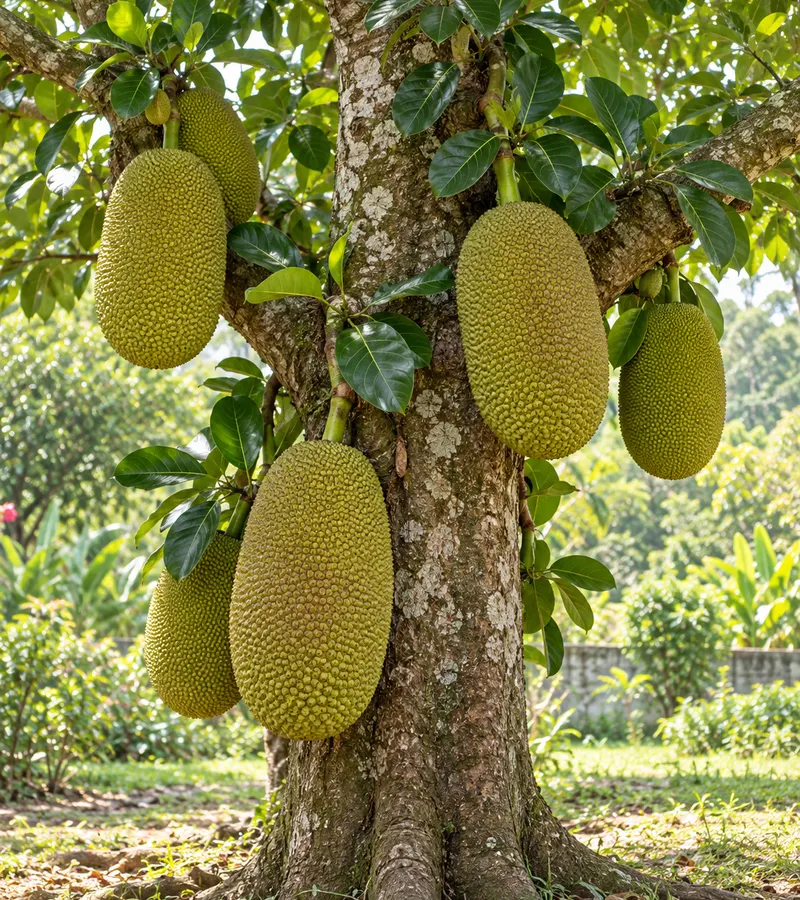
A very large tree whose giant fruit grows straight from the trunk and big limbs; it needs wide space and years of patience.
Care and placement
Needs sun, though young plants want some shade; PFAF says light needs rise as the tree matures. Well-drained soil, preferred pH 5.5–7.5, and it likes moist soil (PFAF contradicts itself on drought; Wikipedia: not drought-resistant beyond a few months). Frost tender (USDA 10–12); Wikipedia: usually grows below 1,600 m, with an optimum of about 19–29 °C.
Draft mature dimensions
Maximum height (cm): 1500 cm · Maximum spread (cm): 1500 cm
Things to consider
The fruit is very heavy (Wikipedia: 4.5–50 kg) and grows on the trunk and big limbs, so falling fruit or laden limbs can injure: plant away from paths, parking and houses (our inference from the weight; the sources do not say). The bark and leaves ooze sticky white latex (Wikipedia). PFAF lists no known hazards, but no toxicity rating exists for children, dogs or cats, so it is not claimed safe.
How to grow and care for it
Planting and pot
Plant only where there is very wide space: PFAF gives about 15 m tall and wide (about 18 m at 20 years), and Wikipedia up to 30 m. Young plants want some shade, and older trees fruit on the trunk and roots (PFAF). Keep it away from houses, pipes and overhead lines, and get permission on public land.
Light
PFAF: grows in part shade or none; young plants need some shade and large trees more light. Wikipedia says it needs sunlight with an optimum of 19–29 °C. Choose a sunny spot for a large tree and shade a young one from harsh sun.
Watering
It prefers moist soil; Wikipedia says it is not drought-resistant beyond a few months, so it needs adequate moisture, with soil that drains (it does best in slightly acidic, moist soil). Water young trees evenly and through long dry seasons (our inference; the sources give no amounts).
Feeding
The sources give no feeding schedule. Add well-rotted organic matter at planting and feed young trees lightly to the label; large trees usually need little extra (general practice; the sources do not say).
Pruning
The sources do not cover pruning. The tree gets very large, so leave high pruning to tree-care crews; while it is low, remove dead and crowded branches to open the crown. Oil your hands and knife so latex does not stick (Wikipedia notes this practice when handling the fruit).
Propagation
PFAF: seed germinates within 10 days and reaches 80–100% in 35–40 days; it loses viability quickly, so sow promptly. Root cuttings, air layering and stem cuttings also work. Wikipedia: usually grown from seed, with first shoots in 10–40 days, and stem cuttings or grafts also work.
Pests and common problems
PFAF says the wood resists termites and rot by fungi and bacteria. The sources I read do not name the main pests and diseases of the living tree, so inspect it regularly and ask local extension advisers. Ripe fruit spoils fast: Wikipedia says cut fruit deteriorates within a few days.
For heavy fruiting
For fruit: a sunny, well-drained spot, even moisture and patience: PFAF says a first crop can come within 3 years but 8 is more common; Wikipedia says 4–14 years. Fruit is ripe when the skin shifts from pale green to greenish brown, smells characteristic and sounds hollow when tapped (Wikipedia), and should be eaten soon after picking.