
Norfolk Island pine
Araucaria heterophylla
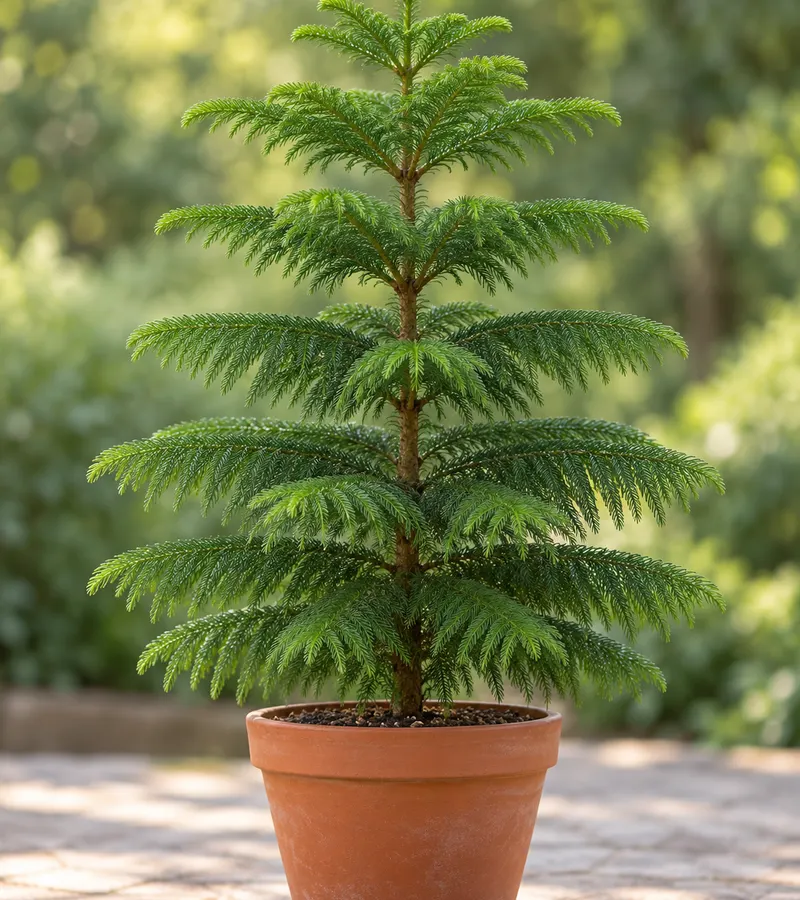
Evenly tiered branches like a Christmas tree, often grown in large pots.
Care and placement
Prefers bright indirect light (about 6 hours), humidity above 50% and 15–24 °C; water when the soil is dry and turn the pot so it does not lean; keep away from air-conditioning drafts.
Draft mature dimensions
Maximum height (cm): 300 cm · Maximum spread (cm): 150 cm
Things to consider
ASPCA lists Araucaria heterophylla as non-toxic to dogs, cats and horses. The sharp needles can scratch; still discourage pets from chewing.
How to grow and care for it
Planting and pot
Use a pot with drain holes and fast-draining soil; empty the saucer after 15 minutes. Outdoors choose a roomy site since it grows tall.
Light
About 6 hours of bright indirect light is ideal indoors, tolerating medium light. Turn the pot regularly so it does not lean. Too little light droops and thins branches.
Watering
Water when the soil is dry, consistently: never let roots dry out fully nor stay wet (about every 7–10 days in summer and 14–21 days in winter for a 25 cm pot — check the soil rather than a calendar). Keep humidity above 50%; a humidifier beats misting.
Feeding
Balanced water-soluble fertilizer at half strength once or twice a month in spring and summer; stop in cool months. Too much feeding weakens the plant's structure.
Pruning
Remove only dead or damaged branches; never cut the leader (growing tip) or the plant loses its form. Lower branches that drop never regrow.
Propagation
Difficult at home: it is grown from seed and cuttings rarely form a proper upright leader. Buying a young plant is more practical.
Pests and common problems
Brown branches: normal for old lower ones; widespread browning or on other branches usually means low humidity (heating, air-conditioning), erratic watering or hard-water mineral buildup. Yellow needles usually mean overwatering or poor drainage. Pest: spider mites — weekly neem oil.
For plentiful, healthy leaves
For an even green crown with neat tiers: bright indirect light, high humidity, regular turning, even watering, light feeding in warm months and an intact leader. As a conifer it does not flower in the usual sense indoors.