
Coral vine
Antigonon leptopus
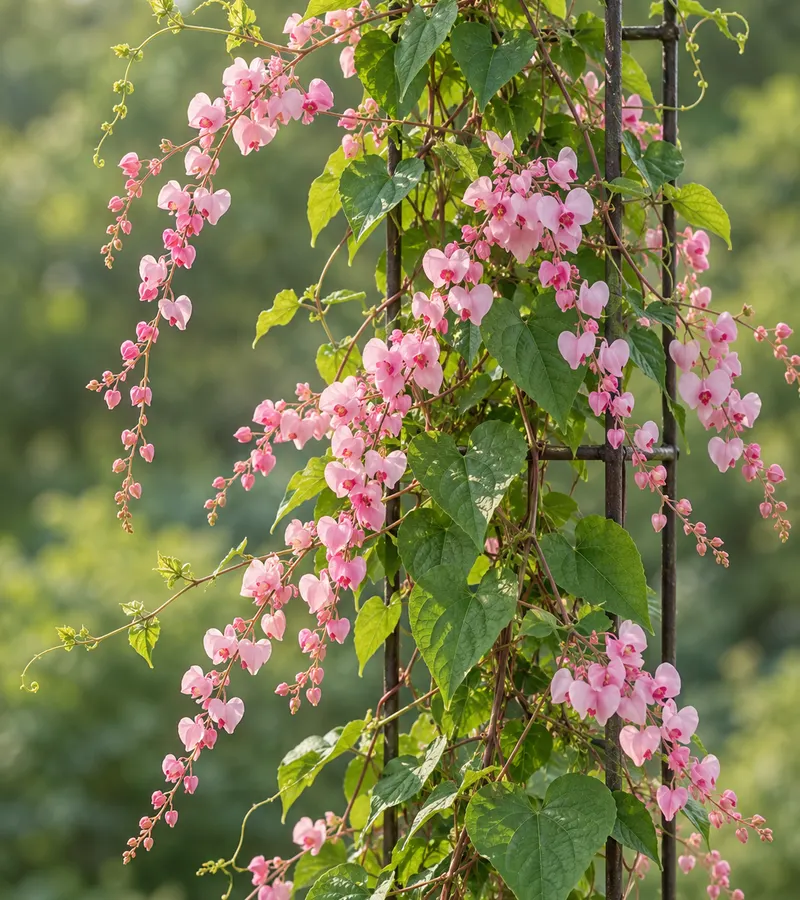
Dense pale-pink heart-shaped flower sprays on a trellis, drawing bees and butterflies.
Care and placement
Needs full sun, well-drained soil and a slender support for its tendrils; moderate drought tolerance; invasive in frost-free humid regions — control seed and tubers.
Draft mature dimensions
Maximum height (cm): 500 cm · Maximum spread (cm): 300 cm
Things to consider
NC State Plant Toolbox does not flag Antigonon leptopus as poisonous; the tubers are eaten in Mexico but should not be eaten without proper knowledge. The vine can be invasive: do not release seed or tubers into the wild.
How to grow and care for it
Planting and pot
Plant in sun in well-drained soil with good air around the roots; give a trellis, mesh or thin wire for the tendrils to grip (a smooth post is useless).
Light
Full sun for the most flowers; tolerates part shade.
Watering
Water deeply and regularly in the first season to establish; then cut back: moderate drought tolerance and dislikes wet sites. Roughly weekly in hot sun, less in part shade.
Feeding
Little fertilizer needed; it flowers in poor soil; a light dose at the start of the growing season is enough. Excess nitrogen gives leaves, few flowers.
Pruning
Where evergreen, prune hard in early spring to keep it in bounds; where frost kills the top, cut dead growth to the ground in late winter and mulch the crown to protect the tubers.
Propagation
Seeds (scarify the hard coat with sandpaper or a nick, or soak in warm water overnight; germinate in 2–4 weeks); softwood tip cuttings with 2–3 nodes and about 21 °C bottom heat; tuber division or layering.
Pests and common problems
Few diseases; in many places it is an invasive weed spreading by seed, tuber, root sucker and stem fragment (listed by Florida as a Category II invasive) — remove spent flowers and fruit and limit its space.
For more flowers
For a cascade of pink sprays: full sun, an open trellis, moderate watering, little fertilizer and a tidy early-season prune. Dense pink flower sprays attract bees and butterflies.