
Flamingo flower
Anthurium andraeanum
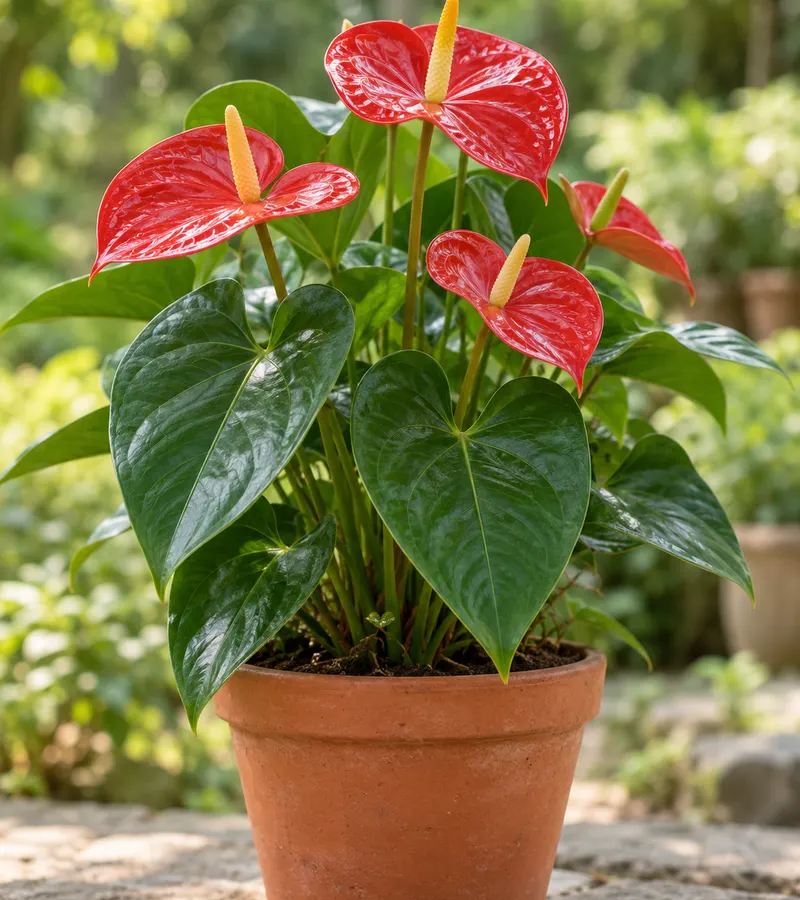
Waxy, glossy red spathes that last long in a bright room.
Care and placement
Prefers bright indirect light, 60–80% humidity and 18–29 °C (65–85 °F); keep an airy mix evenly moist, ideally with rain or filtered water.
Draft mature dimensions
Maximum height (cm): 60 cm · Maximum spread (cm): 50 cm
Things to consider
The genus Anthurium contains insoluble calcium oxalates: toxic to dogs, cats and horses, causing burning, swollen mouth, drooling, vomiting (ASPCA). Sap irritates skin. Keep pets and children from chewing it.
How to grow and care for it
Planting and pot
Use an airy epiphyte/aroid mix (bark, charcoal, coir, perlite) at slightly acidic to neutral pH (about 5.5–6.5) in a pot with drainage holes. Repot every 2–3 years or when roots surface.
Light
Bright indirect light. Too little light is the number-one reason it does not bloom; direct sun scorches leaves and spathes.
Watering
Let the top 2–3 cm dry, then water thoroughly with good drainage; less in autumn and winter. Keep humidity at 60% or more with a pebble tray, humidifier or grouped plants.
Feeding
Use a phosphorus-rich or balanced fertilizer, diluted, every 4–8 weeks in the growing season; none in winter. Too much nitrogen gives leaves instead of flowers.
Pruning
Cut spent flowers off at the base and remove old or damaged leaves.
Propagation
Divide at repotting: separate sections with their own roots and at least 2–3 leaves. Or take a stem cutting with at least two leaves and an aerial root, let it callus for a day, pot in moist airy mix and cover to hold humidity; roots form in 4–6 weeks.
Pests and common problems
Root rot with waterlogged or compacted mix. No blooms usually means low light, excess nitrogen, humidity below 60%, temperature below 18 °C, or a pot-bound plant in exhausted mix. Mealybugs and spider mites may appear.
For more flowers
For more blooms (glossy red spathes): give plenty of bright indirect light, keep warm at 18–29 °C and 60–80% humidity, feed a phosphorus-rich fertilizer regularly, refresh exhausted mix and remove spent flowers.